New Mexico Startup Unveils Ambitious Plan to Transmit Solar Power to Satellites
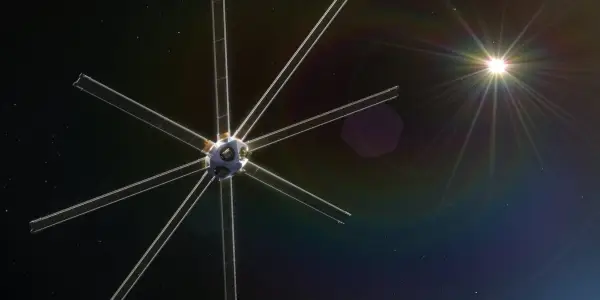
New Mexico's Mantis Space has unveiled a groundbreaking plan to transmit solar power to satellites, securing $10 million in funding to develop innovative ene...
In-depth analysis
New discoveries
We're finally realizing that satellites don't have to be limited by their own shadows. Beaming energy through lasers means power can flow continuously, completely changing how we think about spacecraft design and eliminating those heavy battery constraints we've just accepted for decades.
Mission updates
Mantis Space just secured $10 million to build their prototype, and they're aiming to launch within a couple years. The goal is getting multiple laser beams per satellite up there, testing whether we can actually keep spacecraft powered continuously from above.
Who is affected
Every satellite operator struggling with battery weight and power shortages stands to benefit here. But honestly? This matters for all of us on the ground too—better-powered satellites mean better communications, sharper weather forecasting, and more reliable services we depend on daily.
Next steps
The immediate focus is building that prototype payload and getting it launched. Once they prove the technology works from a single satellite, the real work begins—scaling up to an entire constellation that can beam energy anywhere it's needed in orbit.
Did you know?
Why we should care
This isn't just about satellites—it's about breaking free from limits we thought were unchangeable. When we solve power problems in space, we unlock better internet, more accurate climate monitoring, and technologies that eventually trickle down to improve life here on Earth.
The universe's unsolved mystery
For decades, we've watched satellites go dark every 45 minutes, dying in Earth's shadow like clockwork. We accepted this as inevitable. The real mystery is why it took us this long to ask: what if they never had to switch off at all?
The person who looks at the stars
Eric Truitt probably isn't just chasing profits—he's someone who looked up and saw a problem hiding in plain sight. Every satellite silently struggling through darkness, every engineer accepting battery weight as necessary. Sometimes the people who change things are simply the ones who refuse to accept what everyone else calls normal.
Expert Commentary
This is genuinely exciting to watch unfold. For years, we've accepted that satellites simply die when they're in the dark, and we've loaded them with heavy batteries to cope. Mantis Space is basically asking: why? If we can beam energy wirelessly, we're not just extending satellite lifespans—we're fundamentally rethinking how spacecraft are designed. Dropping battery weight means launching more instruments or reducing costs. It feels like we're watching the early days of something that could become as essential as GPS.

Astronomers Discover Ancient White Dwarf Actively...
Discovery of a Planet Formation Zone Beyond...

Satellite Imagery Highlights Hurricane Damage...

Daily Roundup: November 10, 2025 – Advancements...

Intense Solar Storms Could Ignite Life on...

NASA Unveils New Images of Interstellar Comet...
NASA's ESCAPADE Probes Set for Unique Journey to...

Unistellar eQuinox 2 Smart Telescope Sees...
Interstellar Comet 3I/ATLAS Approaches...
Exploring Oregon's Premier Public Telescope...
James Webb Space Telescope Sheds Light on Early...

NASA's Artemis 3 Moon Mission Delayed to 2028 Due...
Astronauts aboard the ISS Capture Stunning Images...
Assessing the Financial Impact of NASA's Apollo...

Rogue Moons: A New Frontier for Life Beyond Stars

Recent Studies Explore Potential Exoplanet in...
Blue Origin Faces Major Setback as New Glenn...
ISS Crew Takes Precautions Against Radiation...

New Simulations Shed Light on the Enigmatic...
SpaceX Set to Launch NASA's Pandora Exoplanet...

Astronomers Uncover Evidence of Aging Stars...
Jupiter's Moons Io and Europa to Cast Shadows...

Urwerk Unveils Limited-Edition 100V 'LightSpeed'...
The Impact of Space Technology on Everyday Life
Hubble Telescope Unveils Enigmatic Galaxy NGC 2775

The Pleiades Star Cluster Reveals Its Extensive...
Highlights of 2025 in Space Exploration: From...

Astronomers Identify Three Earth-Sized Exoplanets...
The Dwarf III Smart Telescope: A Compact Marvel...
James Webb Space Telescope May Have Detected the...
James Webb Telescope Identifies Rapidly Growing...
SpaceX Achieves 150th Falcon 9 Launch with...
Italian Producer Plans Historic Film to Shoot in...

Exploring the Composition of Cosmic Voids
Webb Telescope Reveals Unprecedented Cosmic...
James Webb Space Telescope Captures Stunning...

Lenovo's Legion Tab Gen 3 Sees Significant Black...
Breakthrough in Milky Way Simulation Using AI...

Portal Systems Aims to Revolutionize Spacecraft...

China's Mars Orbiter Captures Image of...