James Webb Space Telescope May Have Detected the Universe's First Stars
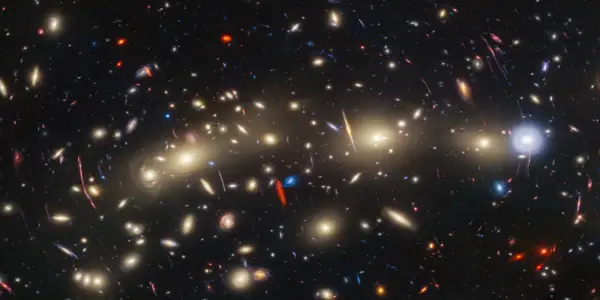
Astronomers using the James Webb Space Telescope may have detected the universe's first stars, revealing insights into early cosmic evolution just 500 millio...
In-depth analysis
New discoveries
Astronomers have potentially identified Population I stars in the galaxy LAP1-B, dating back to just 500 million years after the Big Bang. This discovery enhances understanding of the universe's early evolution and the epoch of reionization, revealing characteristics such as low metallicity and massive sizes compared to modern stars.
Mission updates
The James Webb Space Telescope has successfully captured light from LAP1-B, located 4 billion light-years away, utilizing gravitational lensing from the MACS J galaxy cluster to enhance visibility of these primordial stars.
Who is affected
This discovery impacts researchers studying cosmic evolution, as it provides crucial insights into the formation of galaxies and the properties of dark matter. Understanding Population I stars is essential for astrophysicists seeking to unravel the complexities of the universe's early history.
Next steps
The research team plans to conduct hydrodynamical simulations to investigate the transition from Population I to Population II stars, aiming to deepen knowledge of stellar evolution and the universe's formative processes.
Did you know?
Why we should care
Understanding Population I stars helps unravel the universe's early history, directly impacting our grasp of cosmic evolution. This knowledge may influence our views on dark matter and galaxy formation, which in turn could reshape theories about our own solar system's origins. As discoveries unfold, they remind us that the cosmos is not just a distant realm but integral to understanding our place in the universe.
The universe's unsolved mystery
The quest for Population I stars challenges our comprehension of the universe's infancy. As astronomers probe deeper, they confront questions about dark matter's role in star formation and the very nature of early galaxies. Each discovery unveils more mysteries, pushing the boundaries of our knowledge and posing profound inquiries about the universe's origins and its future.
The person who looks at the stars
Meet Julia, a 12-year-old aspiring astronomer from a small town. Every night, she gazes at the stars with her grandfather's old telescope, dreaming of unraveling cosmic mysteries. The recent discovery of Population I stars ignites her imagination, filling her with wonder about the universe's beginnings. For Julia, these ancient stars symbolize hope and curiosity, reminding her that even the smallest light can shine through the darkest voids. With each revelation from the JWST, she envisions a future where she too might contribute to our understanding of the cosmos—one star at a time.
Potential Evidence of Dark Matter Emerges from...
Ancient Galaxies: A Chaotic Early Universe...
Study Suggests the Universe's Expansion May Be...

NASA and Blue Origin Successfully Launch Dual...
NASA's Ambitious Timeline for Human Exploration...

Samsung Galaxy S26 Expected to Feature Enhanced...
Russian Cosmonauts Conduct Extended Spacewalk to...
Highlights of 2025 in Space Exploration: From...
Intense Solar Storms Could Ignite Life on...

Samsung Unveils Unprecedented Black Friday Deal...
Potential Alien Disclosure May Trigger Bitcoin...

Lenovo's Legion Tab Gen 3 Sees Significant Black...

Urwerk Unveils Limited-Edition 100V 'LightSpeed'...

European Space Agency Unveils Stunning Radar...
Intense Solar Storm May Illuminate Skies Across...
Mapping the Invisible: Astronomers Uncover Dark...
Astronomers Uncover Evidence of Aging Stars...
Interstellar Comet 3I/ATLAS Approaches...

Foundation Season 3 Hints at Deeper Asimov Themes...

Daily Roundup: November 10, 2025 – Advancements...
Rogue Moons: A New Frontier for Life Beyond Stars
Collaboration Between Exoplanet Researchers and...

Satellite Imagery Highlights Hurricane Damage...
Deep Fission Proposes Underground Nuclear...
Astronomers Identify Three Earth-Sized Exoplanets...
Recent Studies Explore Potential Exoplanet in...
Portal Systems Aims to Revolutionize Spacecraft...
NASA's Artemis 3 Moon Mission Delayed to 2028 Due...
Blue Origin Faces Major Setback as New Glenn...

Satellite Imagery Reveals Extensive Damage Across...
Astronomers Uncover a Rapid Star-Forming Galaxy...

Jeff Bezos's AI Hardware Venture Takes Aim at...

Exploring Alternatives to the Meta Quest 3 Elite...
The Dwarf III Smart Telescope: A Compact Marvel...
New Mexico Startup Unveils Ambitious Plan to...
China's Mars Orbiter Captures Image of...
Unraveling the Mysteries of Mars: Recent...

Enhance Your Weather Preparedness with Weather...
Jupiter's Moons Io and Europa to Cast Shadows...