Ancient Galaxies: A Chaotic Early Universe Revealed by JWST
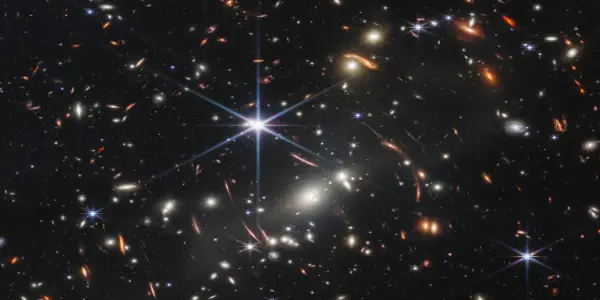
A new study using NASA's James Webb Space Telescope reveals the chaotic nature of early galaxies, showcasing turbulent gas and star formation post-Big Bang.
In-depth analysis
New discoveries
Recent research utilizing NASA's James Webb Space Telescope has revealed that the universe's first galaxies, formed shortly after the Big Bang, were chaotic rather than orderly. These early galaxies exhibited tumultuous star formation and erratic gas movements, challenging previous understandings of galaxy evolution and highlighting a complex transition towards more stable structures.
Mission updates
The James Webb Space Telescope continues to provide unprecedented data on early galaxies, with ongoing observations planned to further explore the interplay between hot ionized gas and colder components.
Who is affected
Astronomers and astrophysicists are significantly impacted by these findings, as they reshape the understanding of cosmic evolution. This research also has implications for the broader scientific community interested in the formation of structures in the universe and the conditions that led to the current cosmic landscape.
Next steps
The research team aims to integrate their findings with future observations of cold gas and dust, enhancing the understanding of early galaxy structures and their evolution in the cosmos.
Did you know?
Why we should care
Understanding the chaotic formation of early galaxies can reshape our perspective on the universe and our place within it. As this research reveals the tumultuous conditions that birthed galaxies, it also highlights the fundamental processes that influence the cosmos today. These insights have implications for our grasp of cosmic history, potentially affecting how we view the evolution of matter and energy that ultimately shapes our world.
The universe's unsolved mystery
The chaotic nature of early galaxies raises profound questions about the forces that shaped our universe. Why did some galaxies stabilize faster than others? What roles did supermassive black holes play in this process? As researchers delve deeper into these mysteries, they are not just piecing together cosmic history but also uncovering the underlying principles of formation that govern not only galaxies but potentially other structures in the universe.
The person who looks at the stars
Meet Maya, a 10-year-old budding astronomer from a small town. Every night, she sets up her telescope in her backyard, gazing up with wonder at the stars. Inspired by the recent discoveries from the James Webb Space Telescope, she dreams of becoming an astrophysicist. For Maya, the revelation of chaotic early galaxies transforms her view of the universe's origins. She imagines the wild gas and turbulent formations as a cosmic playground where stars are born. This connection to the universe fuels her curiosity, reminding us that the mysteries of the cosmos can inspire the next generation of thinkers and dreamers. Maya’s passion encapsulates how profound discoveries in astronomy resonate deeply, encouraging young minds to explore beyond our earthly confines.
New Research Suggests Dark Matter Influences...

Jeff Bezos's AI Hardware Venture Takes Aim at...
Astronomers Identify Ancient Water in...
Study Suggests the Universe's Expansion May Be...

Daily Roundup: November 10, 2025 – Advancements...
Interstellar Comet 3I/ATLAS Approaches...
India Successfully Launches CMS-03 Military...

Unistellar eQuinox 2 Smart Telescope Sees...
Congress Questions NASA's Facility Closures Amid...
Boeing's Upcoming Starliner Mission Set for April...
NASA and Blue Origin Successfully Launch Dual...

Top Black Friday Smartwatch Deals Worth...
Recent Studies Explore Potential Exoplanet in...
Breakthrough in Milky Way Simulation Using AI...
Ancient Earth Chemistry Discovered Beneath Modern...
New Mexico Startup Unveils Ambitious Plan to...

Urwerk Unveils Limited-Edition 100V 'LightSpeed'...
The Pleiades Star Cluster Reveals Its Extensive...
NASA's ESCAPADE Probes Set for Unique Journey to...
Astronomers Discover Ancient White Dwarf Actively...

X-Men Return to Education in Upcoming Comic...

Childcare Crisis: Families Struggle as...
Collaboration Between Exoplanet Researchers and...
X5.1 Solar Flare Triggers G4 Geomagnetic Storm...
Highlights of 2025 in Space Exploration: From...
The Dwarf III Smart Telescope: A Compact Marvel...
NASA's Artemis 3 Moon Mission Delayed to 2028 Due...
Ancient Galaxies: A Chaotic Early Universe...
Discovery of a Planet Formation Zone Beyond...
Astrophysicists Unveil Dark Universe Through...
Deep Fission Proposes Underground Nuclear...
Unusual Wind from Neutron Star Challenges Space...

Samsung's Galaxy S26 Ultra Set for Significant...
New Insights into Gamma Ray Emissions Could...
Astronauts aboard the ISS Capture Stunning Images...

Apple Introduces Emergency SOS via Satellite in...