Astronomers Seek Public Assistance in Uncovering Gravitational Lenses Using Euclid Data
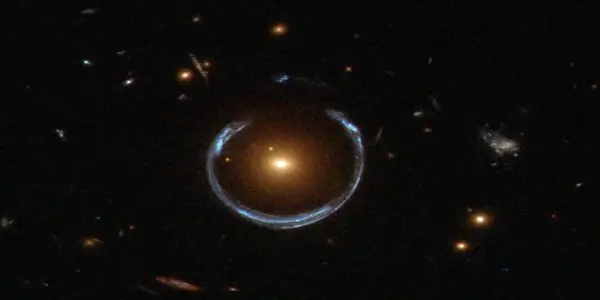
The European Space Agency's Euclid mission invites citizen scientists to help identify gravitational lenses, enhancing our understanding of the universe.
In-depth analysis
New discoveries
The Euclid mission's latest dataset has unveiled a wealth of candidate gravitational lenses, enhancing our understanding of cosmic structures. By engaging citizen scientists, this initiative aims to identify faint arcs and rings that automated systems might miss, potentially leading to new insights about dark matter and the universe's expansion.
Mission updates
The Euclid mission continues to progress, having successfully pre-selected numerous gravitational lens candidates. The collaboration with citizen scientists through the Space Warps initiative marks a significant step in identifying these cosmic phenomena.
Who is affected
This initiative invites participation from individuals across various backgrounds, empowering amateur astronomers and the general public to contribute to significant scientific discoveries. The project aims to cultivate a broader interest in astronomy while enhancing the dataset available to professional researchers.
Next steps
Moving forward, the focus will be on analyzing the contributions from citizen scientists to catalog gravitational lenses. This effort will help deepen our understanding of dark matter and the cosmos, paving the way for future astronomical breakthroughs.
Did you know?
Why we should care
Gravitational lensing is not just a theoretical concept; it impacts our understanding of the universe's composition, including dark matter that influences everything from galaxy formation to the expansion of the cosmos. By participating in the Euclid mission, everyday people can contribute to groundbreaking discoveries that may redefine our knowledge of the universe, connecting us all to the fundamental questions that govern our reality.
The universe's unsolved mystery
Despite decades of research, dark matter remains elusive, constituting roughly 27% of the universe yet remaining undetected. Gravitational lensing offers a rare glimpse into its presence, yet the true nature of dark matter—what it is and how it interacts with visible matter—continues to puzzle scientists. Each new finding from projects like Euclid could bring us closer to unraveling this cosmic enigma.
The person who looks at the stars
Emily Carter, a high school teacher from Maine, spends her evenings gazing at the stars with her children. Their backyard becomes a classroom where they explore the cosmos, igniting curiosity about the universe. When she learned about the Euclid mission, Emily saw a chance to involve her students in identifying gravitational lenses. This project not only teaches them about science but also fosters a sense of wonder and connection to the universe. For Emily, empowering her students to contribute to real scientific discovery transforms stargazing from a hobby into a collaborative quest for knowledge, reminding them that they are part of something larger than themselves.
Expert Commentary
This Week In Space Podcast: Episode 187 Explores...
China's Mars Orbiter Captures Image of...
Affordable Fitness Tracking: The Amazfit Active 2...
Astronomers Capture Unprecedented Black Hole...
Interstellar Comet 3I/ATLAS Approaches...
James Webb Telescope Identifies Rapidly Growing...

Foundation Season 3 Hints at Deeper Asimov Themes...
Astronomers Converge in Phoenix for AAS 247: A...

Unistellar eQuinox 2 Smart Telescope Sees...
Potential Evidence of Dark Matter Emerges from...
Jupiter's Moons Io and Europa to Cast Shadows...

FULU Foundation Introduces Repair Bounty System...
SpaceX Faces Challenges in Meeting NASA's 2027...

OnePlus 15 vs. Samsung Galaxy S25 Plus: A Clash...
Exploring Alternatives to the Meta Quest 3 Elite...
NASA's Campaign to Monitor Interstellar Comet...
NASA and European Partners Prepare for...
ISS Crew Takes Precautions Against Radiation...
Hawaiian Students Honor Gemini North Telescope's...
Young Canadian Astronomer Identifies Two...
The Dwarf III Smart Telescope: A Compact Marvel...
Russian Cosmonauts Conduct Extended Spacewalk to...

Urwerk Unveils Limited-Edition 100V 'LightSpeed'...
Samsung Galaxy S26 Expected to Feature Enhanced...
Astrophysicists Unveil Dark Universe Through...

Lenovo's Legion Tab Gen 3 Sees Significant Black...
The Impact of Space Technology on Everyday Life
Congress Questions NASA's Facility Closures Amid...
Astronomers Identify Potential Earth-Like...
Boeing's Upcoming Starliner Mission Set for April...

NASA's X-59 Achieves Historic Supersonic Flight

Childcare Crisis: Families Struggle as...
Astronomers Uncover Evidence of Aging Stars...
Artemis 2 Astronauts Safely Return After Historic...

Satellite Imagery Reveals Extensive Damage Across...
Exploring the Composition of Cosmic Voids

Jeff Bezos's AI Hardware Venture Takes Aim at...
Enhance Your Weather Preparedness with Weather...
Astronomers Uncover a Rapid Star-Forming Galaxy...