Astronomers Uncover Evidence of Aging Stars Consuming Nearby Planets
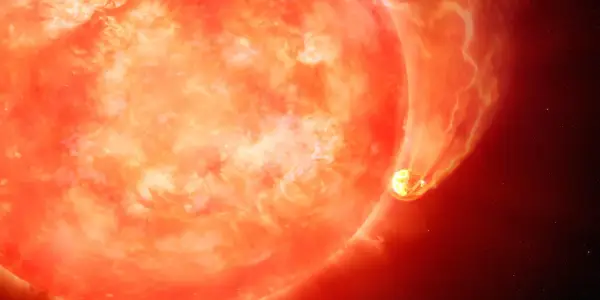
Recent findings indicate that aging stars may be consuming their nearest giant planets as they transition into red giants. This discovery was made using NASA's TESS telescope, which analyzed a vast array of stars.
In-depth analysis
New discoveries
A recent study from the University of Warwick has unveiled that older stars, during their red giant phase, tend to consume closely orbiting giant planets. This groundbreaking research analyzed data from nearly half a million stars, revealing a significant reduction in the presence of these planets as their host stars expand and cool, suggesting many have already been engulfed.
Mission updates
The research team utilized data from NASA's Transiting Exoplanet Survey Satellite (TESS) to identify new and existing giant planets, employing advanced algorithms to detect periodic dimming in stars caused by planetary transits.
Who is affected
The findings have profound implications for the future of our solar system, particularly as our Sun approaches its red giant phase in about five billion years. While Earth may be less vulnerable than closer giant planets, the potential for life to survive during this transition remains uncertain.
Next steps
Further research will focus on refining our understanding of stellar evolution and its effects on planetary systems. Continued analysis of data from TESS and other missions will enhance insights into the fate of planets as their host stars age.
Did you know?
Why we should care
Understanding how older stars consume nearby planets offers crucial insights into the fate of our solar system. As our Sun ages, it will expand and potentially threaten the planets, including Earth. This research serves as a reminder of the cosmic forces at play and the impermanence of our existence, prompting reflection on how we value and protect our planet today.
The universe's unsolved mystery
This study highlights a profound enigma in astrophysics: the long-term stability of planetary systems. While we can observe the demise of giant planets, the mechanisms that could prevent similar fates for smaller, Earth-like planets remain largely speculative. Understanding these dynamics could reshape our knowledge of habitability and the potential for life beyond Earth.
The person who looks at the stars
Meet Elena Torres, a high school science teacher in Tucson, Arizona, who inspires her students with tales of the cosmos. Each night, she gazes at the stars through her telescope, fostering a deep appreciation for the universe's mysteries. The recent findings about aging stars resonate with her lessons on evolution, urging her students to grasp the delicate balance of existence. For Elena, this research isn't just theoretical; it connects to the future of our planet and the profound questions about humanity's place in the universe. Her passion ignites curiosity in her students, reminding them that while the stars may consume their planets, the pursuit of knowledge is an infinite journey.
James Webb Telescope Identifies Rapidly Growing...

This Week In Space Podcast: Episode 187 Explores...

Satellite Imagery Reveals Extensive Damage Across...
NASA's Campaign to Monitor Interstellar Comet...
India Successfully Launches CMS-03 Military...
SpaceX Achieves Major Milestone with Launch of...
Astrophotographer Captures Stunning Image of...
Exploring the Composition of Cosmic Voids

Innovative Portable Reflecting Telescope...
NASA Considers Reopening Bidding for Artemis 3...
NASA's Artemis 3 Moon Mission Delayed to 2028 Due...
NASA's ESCAPADE Probes Set for Unique Journey to...
Andromeda Galaxy's Impact on Its Satellite...
Enhance Your Weather Preparedness with Weather...

Top Black Friday Smartwatch Deals Worth...
New Insights into Gamma Ray Emissions Could...
Astrophysicists Unveil Dark Universe Through...
The Impact of Space Technology on Everyday Life
Astronomers Converge in Phoenix for AAS 247: A...
European Space Agency Unveils Stunning Radar...

Jonathan Davies Urges England to Create New...
Artemis 2 Astronauts Safely Return After Historic...
Astronomers Discover Ancient White Dwarf Actively...

OnePlus 15 vs. Samsung Galaxy S25 Plus: A Clash...
Mapping the Invisible: Astronomers Uncover Dark...
Hawaiian Students Honor Gemini North Telescope's...

Childcare Crisis: Families Struggle as...
Intense Solar Storms Could Ignite Life on...
Astronomers Uncover Evidence of Aging Stars...
James Webb Space Telescope May Have Detected the...
Jupiter's Moons Io and Europa to Cast Shadows...
Euclid Space Telescope Discovers Hidden Stars in...
Rogue Moons: A New Frontier for Life Beyond Stars
Unraveling the Mysteries of Mars: Recent...
China's Mars Orbiter Captures Image of...
Interstellar Comet 3I/ATLAS Approaches...
NASA's X-59 Achieves Historic Supersonic Flight
Webb Telescope Reveals Unprecedented Cosmic...
Unusual Wind from Neutron Star Challenges Space...
Young Canadian Astronomer Identifies Two...