James Webb Telescope Identifies Rapidly Growing Ancient Black Hole
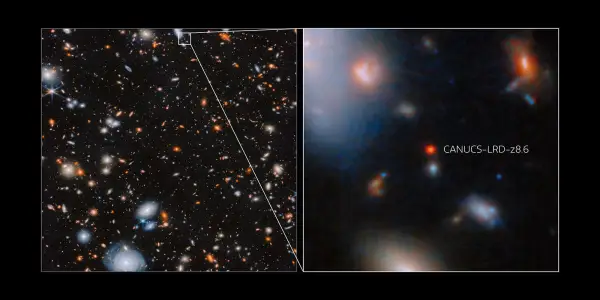
NASA's James Webb Space Telescope has detected a supermassive black hole in a galaxy formed just 570 million years after the Big Bang, challenging existing theories about black hole growth in the early universe.
In-depth analysis
New discoveries
The James Webb Space Telescope has uncovered a supermassive black hole in the galaxy CANUCS-LRD-z8, which existed just 570 million years after the Big Bang. This black hole exhibits an unusually high mass, challenging existing theories about black hole and galaxy formation in the early universe, suggesting that such entities may have developed under distinct conditions.
Mission updates
The JWST has successfully identified spectral signatures of an actively accreting black hole within CANUCS-LRD-z8, utilizing its advanced Near-Infrared capabilities to capture faint light previously undetectable by earlier telescopes.
Who is affected
This discovery impacts the scientific community, particularly astronomers and astrophysicists, who study black hole formation and evolution. It also influences theories regarding the early universe, prompting a reevaluation of established models that link black holes to their host galaxies.
Next steps
The research team plans to conduct additional observations with both the Atacama Large Millimeter/submillimeter Array and the JWST. These efforts aim to investigate more ancient galaxies, potentially uncovering further insights into the nature of early supermassive black holes.
Did you know?
Why we should care
The discovery of an unusually massive black hole in the early universe reshapes our understanding of cosmic evolution. This knowledge not only deepens our grasp of black holes but also enriches our comprehension of the universe's history. It influences everything from astrophysics to how we perceive our own place in the cosmos, reminding us of the complexities that shape our existence and the universe beyond.
The universe's unsolved mystery
Why did CANUCS-LRD-z8’s black hole grow so rapidly, defying established theories? This anomaly raises profound questions about the conditions of the early universe, suggesting that our current models of black hole formation may need a significant overhaul. As researchers delve deeper, they may uncover not just the secrets of black holes, but also the very fabric of cosmic evolution.
The person who looks at the stars
At 12, Sofia Ramirez spends her evenings staring at the night sky from her backyard in New Mexico. Inspired by her grandfather's tales of constellations, she dreams of becoming an astrophysicist. The discovery of CANUCS-LRD-z8 resonates deeply within her; it ignites her curiosity about how galaxies and black holes interact. For Sofia, this isn't just another scientific milestone; it symbolizes her quest for knowledge. Each new finding fuels her desire to explore the universe's mysteries, and she hopes to contribute her own discoveries, bridging the past with the future of cosmic understanding.
New Simulations Shed Light on the Enigmatic...
Intense Solar Storms Could Ignite Life on...
Ancient Galaxies: A Chaotic Early Universe...
James Webb Telescope Identifies Rapidly Growing...
Astronomers Identify Three Earth-Sized Exoplanets...

European Space Agency Unveils Stunning Radar...

ISS Crew Takes Precautions Against Radiation...

NASA's Artemis 3 Moon Mission Delayed to 2028 Due...

Daily Roundup: November 10, 2025 – Advancements...
China's Mars Orbiter Captures Image of...

Satellite Imagery Reveals Extensive Damage Across...
Astrophotographer Captures Stunning Image of...
Highlights of 2025 in Space Exploration: From...
SpaceX Set to Launch NASA's Pandora Exoplanet...
Deep Fission Proposes Underground Nuclear...
Potential Alien Disclosure May Trigger Bitcoin...
Astronomers Discover Ancient White Dwarf Actively...
Webb Telescope Reveals Unprecedented Cosmic...

Enhance Your Weather Preparedness with Weather...
Euclid Space Telescope Discovers Hidden Stars in...
Italian Producer Plans Historic Film to Shoot in...
X5.1 Solar Flare Triggers G4 Geomagnetic Storm...
Astronomers Identify Potential Earth-Like...
NASA's ESCAPADE Probes Set for Unique Journey to...
Astronomers Converge in Phoenix for AAS 247: A...
Mapping the Invisible: Astronomers Uncover Dark...
Unraveling the Mysteries of Mars: Recent...
NASA's X-59 Achieves Historic Supersonic Flight

FULU Foundation Introduces Repair Bounty System...
New Research Suggests Dark Matter Influences...
Russian Cosmonauts Conduct Extended Spacewalk to...

Childcare Crisis: Families Struggle as...
This Week In Space Podcast: Episode 187 Explores...

Samsung Unveils Unprecedented Black Friday Deal...
Andromeda Galaxy's Impact on Its Satellite...
Young Canadian Astronomer Identifies Two...
NASA and European Partners Prepare for...