New Simulations Shed Light on the Enigmatic 'Radio Relics' of Galaxy Clusters
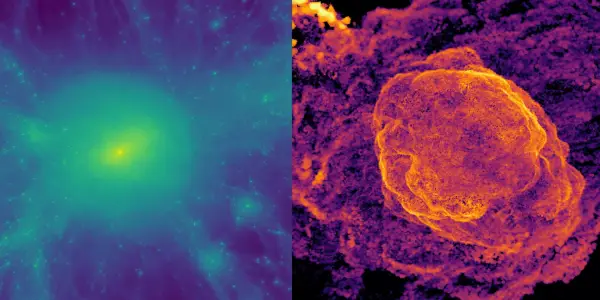
Astronomers unveil new insights into radio relics, puzzling arcs of radio emissions formed in galaxy cluster mergers, challenging existing astrophysical models.
In-depth analysis
New discoveries
Recent research has shed light on the formation of radio relics, revealing that shock waves from galaxy cluster mergers compress surrounding plasma into dense sheets. This process enhances magnetic field strengths and accelerates electrons, providing a clearer understanding of the mechanisms behind these vast arcs of radio emissions, which can span millions of light-years.
Mission updates
The study conducted by the Leibniz Institute for Astrophysics utilized advanced cosmological simulations to explore the dynamics of radio relics, successfully replicating observed radio and X-ray features and addressing longstanding scientific challenges.
Who is affected
This research impacts astrophysicists and cosmologists studying galaxy formation and evolution, as well as those interested in the fundamental physics of the universe. Enhanced understanding of radio relics may also influence related fields, including high-energy astrophysics and plasma physics.
Next steps
Following these findings, further investigations will focus on refining simulation techniques and exploring additional galaxy cluster mergers. This ongoing research aims to deepen insights into cosmic structures and their role in the universe's evolution.
Did you know?
Why we should care
The study of radio relics isn't just about distant galaxies; it affects our understanding of the universe's evolution and the fundamental forces at play. For instance, insights gained from these cosmic structures can enhance technologies on Earth, including advancements in telecommunications and medical imaging. By unraveling the mysteries of how galaxies interact and evolve, we gain knowledge that could influence future scientific breakthroughs relevant to everyday life.
The universe's unsolved mystery
Radio relics represent a fascinating enigma in astrophysics, illustrating the gap between observation and theory. Despite extensive research, the mechanisms behind the formation of these massive structures remain elusive. This ongoing mystery invites further exploration, challenging scientists to reconcile different observational data and push the boundaries of our understanding of cosmic phenomena.
The person who looks at the stars
Meet Clara, a 35-year-old astrophysics teacher who inspires her students with the wonders of the universe. Every evening, she sets up her telescope in her backyard, sharing the beauty of the cosmos with her two young children. Clara's fascination with radio relics has sparked family discussions about the nature of existence and the interconnectedness of all things. As she explains the significance of recent discoveries, Clara emphasizes how these cosmic relics reflect the stories of our own galaxy's past. For her, each radio emission is not just a scientific data point, but a reminder of humanity's quest for knowledge and the shared journey of exploration that connects us to the universe.
ISS Crew Takes Precautions Against Radiation...
NASA Advances Artemis 2 Mission with Orion...
Astronomers Uncover Evidence of Aging Stars...
Assessing the Financial Impact of NASA's Apollo...
Italian Producer Plans Historic Film to Shoot in...
Innovative Portable Reflecting Telescope...
Webb Telescope Reveals Unprecedented Cosmic...
Hubble Telescope Unveils Enigmatic Galaxy NGC 2775
Euclid Space Telescope Discovers Hidden Stars in...
New Simulations Shed Light on the Enigmatic...
Young Canadian Astronomer Identifies Two...
The Pleiades Star Cluster Reveals Its Extensive...
Exploring Oregon's Premier Public Telescope...
Astronauts aboard the ISS Capture Stunning Images...
NASA's Campaign to Monitor Interstellar Comet...
The Dwarf III Smart Telescope: A Compact Marvel...
Rogue Moons: A New Frontier for Life Beyond Stars
SabreSat: An Innovative Air-Breathing Satellite...
Unusual Wind from Neutron Star Challenges Space...
Breakthrough in Milky Way Simulation Using AI...
Collaboration Between Exoplanet Researchers and...
Astronomers Capture Unprecedented Black Hole...
This Week In Space Podcast: Episode 187 Explores...
Interstellar Comet 3I/ATLAS Approaches...

Urwerk Unveils Limited-Edition 100V 'LightSpeed'...
Astronomers Converge in Phoenix for AAS 247: A...
Potential Alien Disclosure May Trigger Bitcoin...
China's Mars Orbiter Captures Image of...

Childcare Crisis: Families Struggle as...
Astronomers Identify Potential Earth-Like...
SpaceX Achieves 150th Falcon 9 Launch with...

Unistellar eQuinox 2 Smart Telescope Sees...
Andromeda Galaxy's Impact on Its Satellite...
NASA's Ambitious Timeline for Human Exploration...

Satellite Imagery Highlights Hurricane Damage...

Intense Solar Storms Could Ignite Life on...