AI Reveals Over 800 New Cosmic Anomalies from Hubble Data
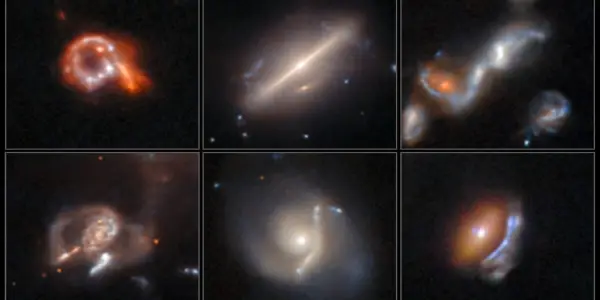
Astronomers have harnessed AI to discover over 800 new cosmic anomalies in Hubble's vast data, showcasing technology's potential to transform astronomical re...
In-depth analysis
New discoveries
The recent application of an AI-driven tool has led to the identification of over 800 unusual cosmic entities within Hubble's archival data. This includes galaxies in interaction, gravitational lenses, and unique jellyfish galaxies, each presenting distinct characteristics that challenge existing classifications and open new research avenues in astrophysics.
Mission updates
The Hubble Space Telescope continues to play a critical role in astronomical research, with the latest findings showcasing the effectiveness of AI in analyzing its vast data archives. This advancement signifies a major leap in understanding cosmic phenomena.
Who is affected
The astronomical community, including researchers and institutions utilizing Hubble’s extensive data, stands to benefit significantly from these findings. The integration of AI tools enhances their ability to analyze large datasets, leading to more comprehensive insights into cosmic phenomena.
Next steps
Future astronomical surveys will likely leverage the capabilities of AI tools like Anomaly Match to process and analyze incoming data. Continued exploration of the newly discovered cosmic entities will further expand our understanding of the universe.
Did you know?
Why we should care
This breakthrough in AI-driven analysis holds the potential to reshape our understanding of the universe. The discovery of over 800 unusual cosmic entities could lead to new insights about galaxy formation, dark matter, and the fundamental nature of reality. For everyday people, these revelations could inspire future generations of scientists and advance technology in fields like telecommunications and navigation, which rely on understanding complex cosmic phenomena.
The universe's unsolved mystery
Despite decades of astronomical research, many cosmic phenomena remain enigmatic. The newly identified gravitational lenses and jellyfish galaxies challenge existing theories about galaxy interactions and the behavior of light in extreme environments. These anomalies beckon further investigation, driving scientists to reassess their models of the universe and explore the unknown, highlighting the infinite complexities of cosmic evolution.
The person who looks at the stars
Meet Clara, a 12-year-old aspiring astronomer from a small town. Every night, she gazes through her father’s old telescope, dreaming of what lies beyond. When she learned about the 800 newly discovered cosmic entities, her heart raced at the thought of being part of a generation that could unlock the universe's secrets. Clara’s fascination isn’t just about stars; it's about the stories they tell and the mysteries they hold. Inspired by the potential of AI tools like Anomaly Match, she imagines a future where she might contribute to finding answers to questions that have puzzled humanity for centuries. Clara embodies the hope and curiosity that drives scientific exploration, reminding us that the stars are not just for observing—they're for understanding.
The Impact of Space Technology on Everyday Life

Foundation Season 3 Hints at Deeper Asimov Themes...
SabreSat: An Innovative Air-Breathing Satellite...
New Simulations Shed Light on the Enigmatic...
Young Canadian Astronomer Identifies Two...
Astronauts aboard the ISS Capture Stunning Images...

Exploring Alternatives to the Meta Quest 3 Elite...
Astrophotographer Captures Stunning Image of...
Ancient Galaxies: A Chaotic Early Universe...
Jupiter's Moons Io and Europa to Cast Shadows...
Recent Studies Explore Potential Exoplanet in...

Childcare Crisis: Families Struggle as...
The Pleiades Star Cluster Reveals Its Extensive...
Exploring the Composition of Cosmic Voids
Study Suggests the Universe's Expansion May Be...

European Space Agency Unveils Stunning Radar...
Discovery of a Planet Formation Zone Beyond...
Assessing the Financial Impact of NASA's Apollo...

OnePlus 15 vs. Samsung Galaxy S25 Plus: A Clash...

Top Black Friday Smartwatch Deals Worth...

Lenovo's Legion Tab Gen 3 Sees Significant Black...

Innovative Portable Reflecting Telescope...
Astronomers Uncover Evidence of Aging Stars...
The Dwarf III Smart Telescope: A Compact Marvel...
Astrophysicists Unveil Dark Universe Through...

NASA and Blue Origin Successfully Launch Dual...
AI Reveals Over 800 New Cosmic Anomalies from...
ISS Crew Takes Precautions Against Radiation...
Blue Origin Faces Major Setback as New Glenn...

Meteorite Fragment May Have Impacted Houston Home
James Webb Space Telescope Discovers Ancient...
Intense Solar Storm May Illuminate Skies Across...

Astronomers Identify Three Earth-Sized Exoplanets...
Boeing's Upcoming Starliner Mission Set for April...
Charlotte: The Lunar 3D Printer Poised to...
James Webb Space Telescope Captures Stunning...
Hawaiian Students Honor Gemini North Telescope's...
NASA's Campaign to Monitor Interstellar Comet...