Study Suggests the Universe's Expansion May Be Slowing Down
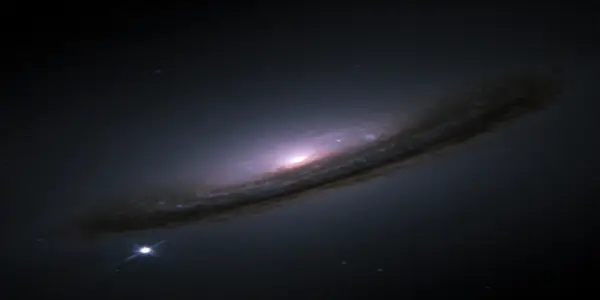
A recent study indicates that the universe's expansion might be slowing, challenging the long-held belief that it has been accelerating due to dark energy.
In-depth analysis
New discoveries
The recent study challenges the long-held belief that the universe's expansion is accelerating, suggesting instead that it may be slowing down. By correcting for age biases in supernova observations, researchers found that the data aligns more closely with a model indicating the evolution of dark energy over time, a significant shift in cosmological understanding.
Mission updates
The Yonsei research team plans to conduct further investigations focusing on supernovae from younger coeval host galaxies. These studies aim to validate their findings and deepen the understanding of dark energy's role in cosmic expansion.
Who is affected
This research impacts astronomers and cosmologists worldwide, as it challenges existing theories about dark energy and the universe's expansion. It may also influence educational curricula and public understanding of fundamental astrophysical concepts.
Next steps
The Yonsei team will carry out additional studies over the next five years to further explore supernovae characteristics. These efforts are expected to enhance insights into dark energy and refine current cosmological models.
Did you know?
Why we should care
Understanding whether the universe's expansion is slowing down or accelerating affects not just theoretical physics but also our grasp of fundamental cosmic processes. This knowledge could influence technologies relying on precise measurements, such as GPS and satellite communications, which depend on our understanding of gravity and space-time. The implications stretch into the future of cosmology, potentially reshaping our view of existence itself.
The universe's unsolved mystery
If dark energy is evolving rather than constant, it suggests that our understanding of the universe is far from complete. This notion opens avenues for theoretical exploration that could redefine physics. As scientists delve deeper into these cosmic questions, the pursuit of knowledge may lead to unexpected discoveries about the nature of reality and our place within it.
The person who looks at the stars
Maria Gonzalez, an amateur astronomer from Tucson, Arizona, spends her evenings gazing at the night sky, notebook in hand. Each star holds a story, a connection to the cosmos that fuels her curiosity. The recent study on the universe's expansion captivates her imagination, prompting her to wonder how such findings might alter our understanding of existence. For Maria, the possibility that the universe could be slowing down ignites a sense of urgency; she feels a responsibility to share her passion for astronomy with the younger generation. Inspired by figures like Professor Young-Wook Lee, Maria organizes local stargazing events, hoping to spark similar interest in others. As she peers through her telescope, she dreams of a future where she might contribute to unraveling the mysteries of dark energy, bridging the gap between everyday lives and the vast universe.
NASA's Ambitious Timeline for Human Exploration...
SpaceX Faces Challenges in Meeting NASA's 2027...
Astronomers Converge in Phoenix for AAS 247: A...
Astronomers Identify Three Earth-Sized Exoplanets...
Astrophotographer Captures Stunning Image of...
Exploring the Composition of Cosmic Voids
James Webb Space Telescope May Have Detected the...
Apple Introduces Emergency SOS via Satellite in...

X-Men Return to Education in Upcoming Comic...
Webb Telescope Reveals Unprecedented Cosmic...
India Successfully Launches CMS-03 Military...

Childcare Crisis: Families Struggle as...

Samsung's Galaxy S26 Ultra Set for Significant...

Daily Roundup: November 10, 2025 – Advancements...
The Pleiades Star Cluster Reveals Its Extensive...

Jeff Bezos's AI Hardware Venture Takes Aim at...
NASA's X-59 Achieves Historic Supersonic Flight
Boeing's Upcoming Starliner Mission Set for April...
Astronomers Discover Ancient White Dwarf Actively...
Congress Questions NASA's Facility Closures Amid...
Unusual Wind from Neutron Star Challenges Space...
AI Reveals Over 800 New Cosmic Anomalies from...
Exploring the Best Online Resources for Stunning...
Astronauts aboard the ISS Capture Stunning Images...
Innovative Portable Reflecting Telescope...
New Insights into Gamma Ray Emissions Could...
NASA Unveils New Images of Interstellar Comet...
Astronomers Identify Ancient Water in...
New Mexico Startup Unveils Ambitious Plan to...
Collaboration Between Exoplanet Researchers and...
NASA Considers Reopening Bidding for Artemis 3...
James Webb Space Telescope Captures Stunning...
This Week In Space Podcast: Episode 187 Explores...
Rogue Moons: A New Frontier for Life Beyond Stars
Expansion of Earth’s Magnetic Field Weak Spot...
Young Canadian Astronomer Identifies Two...
Ancient Galaxies: A Chaotic Early Universe...
Highlights of 2025 in Space Exploration: From...