Astronomers Discover Ancient White Dwarf Actively Accreting Material from Its Planetary System
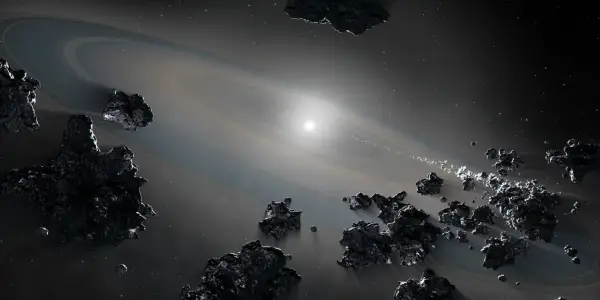
An international team of astronomers has identified a 3 billion-year-old white dwarf that is still consuming material from its former planetary system, raising questions about the evolution of stellar remnants.
In-depth analysis
New discoveries
A 3-billion-year-old white dwarf is still snacking on its former planet! LSPM J's atmosphere shows magnesium and iron from a rocky body—probably pushed inward by a Jupiter-like planet. Star corpses can be messy eaters.
Mission updates
Keck Observatory's High Resolution Echelle Spectrometer caught these heavy elements in the hydrogen-rich debris disk. Trottier Institute + Carnegie team watching our solar system's possible future play out 150 light-years away.
Who is affected
Anyone wondering what happens to Earth when the Sun dies. Planetary system evolution theories just got rewritten. White dwarfs aren't quiet graves—they're active crime scenes.
Next steps
Gaia and JWST need to study this system. Figure out exactly how that planet disrupted the rocky body. Our own fate depends on understanding these cosmic leftovers.
Did you know?
Why we should care
Understanding the life cycle of stars like LSPM J directly informs predictions about our solar system's future. As the Sun will eventually become a white dwarf, insights into these stellar remnants can shape our understanding of cosmic events that may affect Earth, including potential changes in gravitational dynamics or the fate of planetary bodies. This knowledge is vital for comprehending how life on Earth might evolve—or struggle—in a vastly transformed solar system.
The universe's unsolved mystery
The processes governing the interactions between white dwarfs and their planetary remnants remain enigmatic. Why do some white dwarfs exhibit ongoing accretion while others do not? This question hints at broader themes in astrophysics, such as the stability of planetary systems and the longevity of stellar remnants, inviting further exploration into the hidden complexities of the universe.
The person who looks at the stars
In a small town in Arizona, 12-year-old Maya Torres often lies on her backyard trampoline, gazing at the stars with wide eyes. Inspired by her grandfather, an amateur astronomer, she dreams of uncovering the universe’s secrets. The recent discovery of LSPM J resonates deeply with her. Maya imagines how distant celestial bodies could hold remnants of life, just like Earth. This connection fuels her curiosity about science and inspires her to pursue a career in astronomy, proving that discoveries light up dreams, bridging the gap between the cosmos and our everyday lives.
Expert Commentary
This discovery of LSPM J actively accreting planetary material is fascinating. It challenges our assumptions about the late stages of stellar evolution and shows that planetary remnants can remain dynamically active even billions of years after a star’s death. This could reshape how we model the fate of our own solar system.

AI Reveals Over 800 New Cosmic Anomalies from...

European Space Agency Unveils Stunning Radar...
Astronomers Capture Unprecedented Black Hole...

Astronomers Uncover a Rapid Star-Forming Galaxy...
Andromeda Galaxy's Impact on Its Satellite...
Interstellar Comet 3I/ATLAS Approaches...

SabreSat: An Innovative Air-Breathing Satellite...
Highlights of 2025 in Space Exploration: From...

NASA's X-59 Achieves Historic Supersonic Flight

Portal Systems Aims to Revolutionize Spacecraft...

Rogue Moons: A New Frontier for Life Beyond Stars
Astronomers Discover Ancient White Dwarf Actively...

X-Men Return to Education in Upcoming Comic...
NASA Advances Artemis 2 Mission with Orion...

Potential Alien Disclosure May Trigger Bitcoin...
NASA's ESCAPADE Probes Set for Unique Journey to...
Recent Studies Explore Potential Exoplanet in...
NASA's Ambitious Timeline for Human Exploration...

Daily Roundup: November 10, 2025 – Advancements...

Satellite Imagery Highlights Hurricane Damage...
Mapping the Invisible: Astronomers Uncover Dark...

NASA Unveils New Images of Interstellar Comet...
New Mexico Startup Unveils Ambitious Plan to...
Astrophotographer Captures Stunning Image of...

James Webb Telescope Identifies Rapidly Growing...
Ancient Galaxies: A Chaotic Early Universe...
Assessing the Financial Impact of NASA's Apollo...
Unraveling the Mysteries of Mars: Recent...

NASA and European Partners Prepare for...

OnePlus 15 vs. Samsung Galaxy S25 Plus: A Clash...
Study Suggests the Universe's Expansion May Be...
Astronomers Uncover Evidence of Aging Stars...
SpaceX Faces Challenges in Meeting NASA's 2027...
Collaboration Between Exoplanet Researchers and...

Artemis 2 Astronauts Safely Return After Historic...

Lenovo's Legion Tab Gen 3 Sees Significant Black...

X5.1 Solar Flare Triggers G4 Geomagnetic Storm...

Blue Origin Faces Major Setback as New Glenn...