NASA's James Webb Telescope Discovers Weather Patterns on Distant Exoplanet WASP-121b
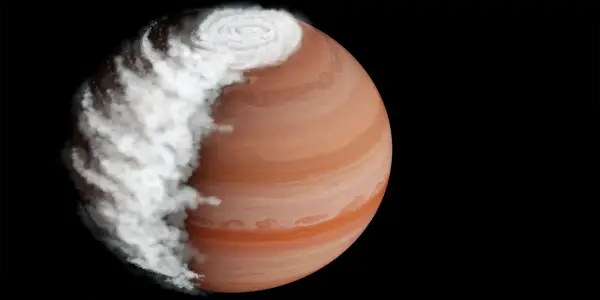
NASA's James Webb Space Telescope reveals unique weather patterns on exoplanet WASP-121b, shedding light on its atmospheric dynamics.
In-depth analysis
New discoveries
NASA's James Webb Space Telescope has unveiled unprecedented insights into WASP-121b's atmosphere, revealing distinct weather patterns for the first time. The stark contrast between its clear 'morning' side and cloud-covered 'evening' side suggests complex atmospheric dynamics, with clouds likely composed of magnesium silicate and iron, diverging significantly from Earth's water vapor clouds.
Mission updates
Recent observations from the JWST have advanced the understanding of exoplanetary atmospheres, particularly through the study of WASP-121b. This research builds upon earlier findings from other hot Jupiters, indicating the telescope's ongoing contributions to planetary science.
Who is affected
The findings from WASP-121b's atmospheric study have implications for astronomers and researchers focused on exoplanetary science. By challenging existing models of atmospheric dynamics, the study may influence future research directions and methodologies in understanding the climate and composition of distant worlds.
Next steps
Future research will likely focus on expanding observations to include a wider range of exoplanets, particularly smaller, Earth-like candidates. Continued advancements in telescope technology promise to enhance our understanding of atmospheric conditions across diverse planetary systems.
Did you know?
Why we should care
Understanding the weather patterns of exoplanets like WASP-121b can reshape our perspective on planetary atmospheres, potentially influencing how we search for habitable worlds. As scientists unravel the complexities of these distant gas giants, we gain insights that could inform future explorations, drive technological advancements, and even help us understand our own planet's climate and atmospheric behavior in the context of a vast universe.
The universe's unsolved mystery
The stark differences in atmospheric conditions between WASP-121b’s hemispheres raise profound questions about the forces shaping exoplanetary weather. How do these dynamics compare to Earth’s own atmospheric systems? Investigating these phenomena not only enhances our understanding of exoplanets but could also provide clues about the fundamental processes governing weather across the cosmos.
The person who looks at the stars
At a local observatory, 12-year-old Mia Thompson peers through a telescope, her eyes wide with wonder as she learns about the mysteries of planets like WASP-121b. Inspired by the JWST's findings, she dreams of becoming an astronomer. Each night, she sketches the night sky and imagines the weather on distant worlds. For Mia, these discoveries are not just scientific breakthroughs; they ignite her passion for exploration, showing her that even the most distant stars hold stories waiting to be uncovered.
Expert Commentary
SabreSat: An Innovative Air-Breathing Satellite...

European Space Agency Unveils Stunning Radar...

Exploring Alternatives to the Meta Quest 3 Elite...
Rogue Moons: A New Frontier for Life Beyond Stars
James Webb Space Telescope Captures Stunning...

Samsung Unveils Unprecedented Black Friday Deal...

OnePlus 15 vs. Samsung Galaxy S25 Plus: A Clash...
Young Canadian Astronomer Identifies Two...

Deep Fission Proposes Underground Nuclear...
Exploring the Composition of Cosmic Voids

Satellite Imagery Reveals Extensive Damage Across...
Astronomers Discover Ancient White Dwarf Actively...
X5.1 Solar Flare Triggers G4 Geomagnetic Storm...
Portal Systems Aims to Revolutionize Spacecraft...
NASA's Artemis 3 Moon Mission Delayed to 2028 Due...

Top Black Friday Smartwatch Deals Worth...
Hubble Telescope Unveils Enigmatic Galaxy NGC 2775
Collaboration Between Exoplanet Researchers and...
Astrophotographer Captures Stunning Image of...

X-Men Return to Education in Upcoming Comic...

Astronauts aboard the ISS Capture Stunning Images...
ISS Crew Takes Precautions Against Radiation...
Potential Evidence of Dark Matter Emerges from...
Astronomers Identify Potential Earth-Like...
NASA's Campaign to Monitor Interstellar Comet...
Astronomers Converge in Phoenix for AAS 247: A...
Breakthrough in Milky Way Simulation Using AI...
Apple Introduces Emergency SOS via Satellite in...
Astronomers Uncover a Rapid Star-Forming Galaxy...
James Webb Space Telescope Discovers Ancient...

Samsung Galaxy S26 Expected to Feature Enhanced...
Assessing the Financial Impact of NASA's Apollo...
Blue Origin Faces Major Setback as New Glenn...
New Research Suggests Dark Matter Influences...
Webb Telescope Reveals Unprecedented Cosmic...
Astronomers Capture Unprecedented Black Hole...
James Webb Telescope Identifies Rapidly Growing...