James Webb Space Telescope Discovers Ancient Supermassive Black Hole 'BiRD'
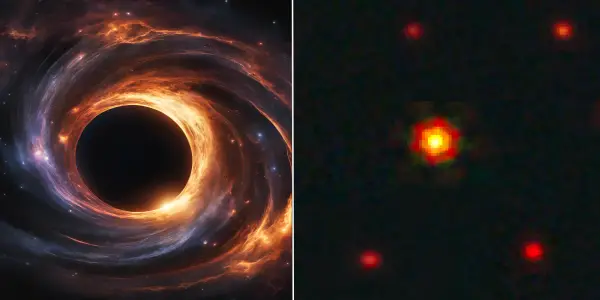
The James Webb Space Telescope has unveiled a supermassive black hole, named 'BiRD,' from the early universe, enhancing our understanding of black hole formation and evolution.
In-depth analysis
New discoveries
Astronomers have identified a supermassive black hole named 'BiRD' using the James Webb Space Telescope, dating back approximately 4 billion years. This discovery enhances understanding of supermassive black hole formation during a crucial cosmic era and highlights the advanced capabilities of the JWST in revealing previously hidden celestial phenomena.
Mission updates
The JWST continues to provide groundbreaking infrared observations, enabling astronomers to analyze distant cosmic objects. Recent findings emphasize the telescope's role in reshaping our understanding of early black hole development.
Who is affected
The discovery of BiRD impacts the scientific community, particularly astrophysicists studying black hole formation and evolution. It also influences broader astronomical research, potentially altering theories about the early universe and the nature of supermassive black holes.
Next steps
Researchers plan to conduct further investigations into the characteristics of BiRD and other little red dots. Expanding the sample size will deepen insights into the formation of supermassive black holes and their significance in cosmic history.
Did you know?
Why we should care
The discovery of BiRD, a supermassive black hole from 4 billion years ago, has profound implications for our understanding of the universe. It challenges previous beliefs about black hole formation and growth during a critical era. This knowledge could influence how we view the cosmos and our place within it, impacting everything from scientific research to technological innovations derived from space exploration.
The universe's unsolved mystery
BiRD represents more than just a celestial body; it embodies the mysteries of cosmic evolution. The enigma of how supermassive black holes formed and grew in the early universe remains largely unanswered. Each discovery, including BiRD, adds a piece to a puzzle that could redefine our understanding of gravity, matter, and the very fabric of the universe.
The person who looks at the stars
Meet Elena Torres, a 12-year-old aspiring astronomer from Tucson, Arizona. Each night, she sets up her telescope, gazing at the stars with wonder. When she learned about BiRD, Elena felt a rush of excitement—this ancient black hole was a reminder that the universe holds secrets waiting to be uncovered. Inspired, she dreams of discovering new celestial bodies one day. For Elena, the cosmos is not just a vast expanse; it’s a personal adventure that fuels her imagination and determination to contribute to science, bridging the gap between everyday life and the mysteries of the universe.
James Webb Telescope Identifies Rapidly Growing...

This Week In Space Podcast: Episode 187 Explores...

Satellite Imagery Reveals Extensive Damage Across...
NASA's Campaign to Monitor Interstellar Comet...
Astrophysicists Unveil Dark Universe Through...

SpaceX Achieves Major Milestone with Launch of...
Astrophotographer Captures Stunning Image of...
Exploring the Composition of Cosmic Voids
Innovative Portable Reflecting Telescope...
NASA Considers Reopening Bidding for Artemis 3...

NASA's Artemis 3 Moon Mission Delayed to 2028 Due...
NASA's ESCAPADE Probes Set for Unique Journey to...
Andromeda Galaxy's Impact on Its Satellite...
Enhance Your Weather Preparedness with Weather...

Top Black Friday Smartwatch Deals Worth...
New Insights into Gamma Ray Emissions Could...
New Mexico Startup Unveils Ambitious Plan to...
The Impact of Space Technology on Everyday Life
Astronomers Converge in Phoenix for AAS 247: A...
European Space Agency Unveils Stunning Radar...

Jonathan Davies Urges England to Create New...
Jupiter's Moons Io and Europa to Cast Shadows...
Astronomers Discover Ancient White Dwarf Actively...

OnePlus 15 vs. Samsung Galaxy S25 Plus: A Clash...
Mapping the Invisible: Astronomers Uncover Dark...
Hawaiian Students Honor Gemini North Telescope's...

Childcare Crisis: Families Struggle as...
Intense Solar Storms Could Ignite Life on...
Astronomers Uncover Evidence of Aging Stars...
James Webb Space Telescope May Have Detected the...

FULU Foundation Introduces Repair Bounty System...
Rogue Moons: A New Frontier for Life Beyond Stars
Euclid Space Telescope Discovers Hidden Stars in...
Unraveling the Mysteries of Mars: Recent...
China's Mars Orbiter Captures Image of...
Interstellar Comet 3I/ATLAS Approaches...
NASA's X-59 Achieves Historic Supersonic Flight
Webb Telescope Reveals Unprecedented Cosmic...
Unusual Wind from Neutron Star Challenges Space...
Young Canadian Astronomer Identifies Two...