Exploring the Unique Role of Telescope Rancher in McCulloch County, Texas
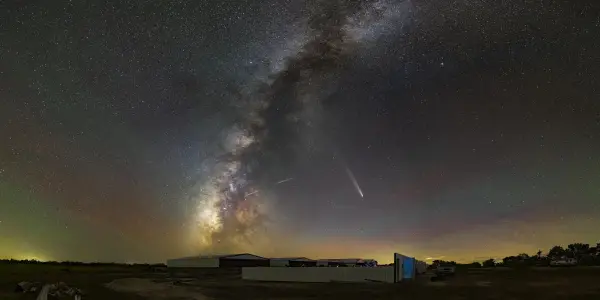
In McCulloch County, Texas, a telescope rancher offers a unique astronomy experience, combining remote observatory access with expert support.
In-depth analysis
New discoveries
Recent findings from Bray's Starscope Observatory include a remarkable supernova remnant located 20 degrees off the galactic plane. This discovery highlights the observatory's dual role as a recreational site and a contributor to significant astronomical research, demonstrating the potential for amateur astronomers to make valuable contributions to the scientific community.
Mission updates
Bray's Starscope Observatory continues to enhance its services by allowing users to rent telescopes remotely. This initiative not only broadens access to stargazing but also supports ongoing technical assistance for users, ensuring a seamless experience.
Who is affected
Amateur astronomers, researchers, and stargazing enthusiasts are directly impacted by the innovations at Bray's observatory. The facility caters to a diverse audience, providing opportunities for exploration and scientific discovery, regardless of their physical location.
Next steps
Looking ahead, Bray plans to expand the range of telescopes available for remote rental. This expansion aims to accommodate a wider variety of users and enhance the overall stargazing experience, further integrating technology into astronomy.
Did you know?
Why we should care
Stargazing isn't just a pastime; it can spark curiosity about the universe and inspire future scientists. In a world dominated by screens and artificial lights, McCulloch County offers a rare opportunity to connect with the cosmos. This connection can lead to increased interest in science, technology, and environmental stewardship, reminding us of our place in the universe and the importance of preserving dark skies for future generations.
The universe's unsolved mystery
Despite advancements in astronomy, many questions linger about dark matter and dark energy, which together constitute about 95% of the universe. Understanding these enigmatic components could unlock secrets about the universe's origin and fate, highlighting the vast unknowns that still await discovery. Observatories like Bray's may one day play a crucial role in uncovering these cosmic puzzles.
The person who looks at the stars
Meet Clara, a retired school teacher from Austin, who finds solace in the night sky. After discovering Bray's Starscope Observatory, she became a regular visitor, captivated by the clarity of constellations and the thrill of observing celestial events. For Clara, stargazing has transformed into a meditative practice, allowing her to reflect on life's mysteries while sharing her passion with fellow enthusiasts. As she peers through the telescope, she experiences a profound connection to the universe, reminding her that curiosity knows no age. This communal experience at the observatory has enriched her retirement, fostering friendships and reigniting her love for science. Clara’s journey exemplifies how stargazing can inspire personal growth and community bonds.
Expert Commentary
Unusual Wind from Neutron Star Challenges Space...
Highlights of 2025 in Space Exploration: From...
Hawaiian Students Honor Gemini North Telescope's...
Recent Studies Explore Potential Exoplanet in...
James Webb Space Telescope Discovers Ancient...
Astronomers Identify Potential Earth-Like...
Andromeda Galaxy's Impact on Its Satellite...

Astronomers Discover Ancient White Dwarf Actively...
Meteorite Fragment May Have Impacted Houston Home
Boeing's Upcoming Starliner Mission Set for April...
Fintech Founder Champions Innovation Through...

NASA and European Partners Prepare for...

OnePlus 15 vs. Samsung Galaxy S25 Plus: A Clash...
SpaceX Achieves 150th Falcon 9 Launch with...
Assessing the Financial Impact of NASA's Apollo...
Breakthrough in Milky Way Simulation Using AI...

Samsung's Galaxy S26 Ultra Set for Significant...
New Research Suggests Dark Matter Influences...
Astronomers Identify Ancient Water in...
Potential Alien Disclosure May Trigger Bitcoin...
Italian Producer Plans Historic Film to Shoot in...
Innovative Portable Reflecting Telescope...
Webb Telescope Reveals Unprecedented Cosmic...
James Webb Space Telescope Captures Stunning...
Ancient Galaxies: A Chaotic Early Universe...
Euclid Space Telescope Discovers Hidden Stars in...

Daily Roundup: November 10, 2025 – Advancements...

Congress Questions NASA's Facility Closures Amid...
SpaceX Achieves Major Milestone with Launch of...
The Impact of Space Technology on Everyday Life
X5.1 Solar Flare Triggers G4 Geomagnetic Storm...

Satellite Imagery Highlights Hurricane Damage...
Young Canadian Astronomer Identifies Two...

SabreSat: An Innovative Air-Breathing Satellite...
Intense Solar Storms Could Ignite Life on...

Jonathan Davies Urges England to Create New...
Rogue Moons: A New Frontier for Life Beyond Stars