Hubble Survey Prepares for Roman Telescope's Exploration of the Milky Way's Core
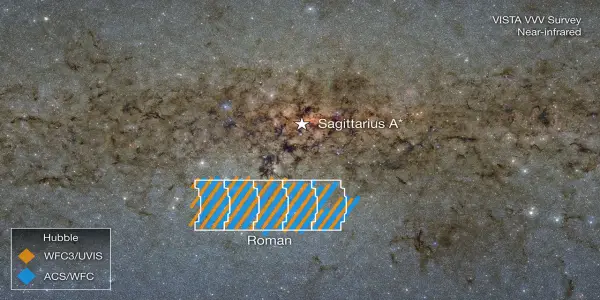
NASA's Hubble survey enhances understanding of the Milky Way's galactic bulge, setting the stage for the upcoming Roman Space Telescope's observations.
In-depth analysis
New discoveries
The collaboration between the Hubble Space Telescope and the upcoming Nancy Grace Roman Space Telescope is set to revolutionize our understanding of the Milky Way's galactic bulge. This unique focus on the densely packed region promises to uncover thousands of new celestial bodies, including rogue planets and isolated neutron stars, enriching the astronomical catalog.
Mission updates
The Roman Space Telescope's Galactic Bulge Time-Domain Survey is poised to begin, utilizing its advanced capabilities to capture rapid observations across a significant area of the galactic bulge. This strategic initiative will enhance the depth of astronomical research.
Who is affected
Astronomers and astrophysicists stand to gain immensely from the insights provided by the Roman Space Telescope's observations. The data will not only aid in identifying new celestial objects but also refine existing models of star formation and evolution, impacting research across multiple fields.
Next steps
As the Roman Space Telescope prepares for its mission, the focus will shift to integrating data from Hubble's extensive catalog. This foundational dataset will be crucial for enhancing the accuracy of upcoming observations and analyses of the galactic bulge.
Did you know?
Why we should care
Understanding the Milky Way's galactic bulge isn't just an academic pursuit; it influences our grasp of the universe's evolution. With the Roman Space Telescope, the potential discovery of new stars and planets could redefine our place in the cosmos. For everyday people, these revelations could lead to advancements in technology and energy, derived from our understanding of celestial mechanics and materials.
The universe's unsolved mystery
The galactic bulge is a treasure trove of unanswered questions, from the origins of rogue planets to the nature of dark matter. As the Roman Space Telescope explores this dense region, it may unravel the connections between these celestial phenomena, revealing whether our galaxy's formation aligns with current cosmic theories or requires entirely new models.
The person who looks at the stars
Meet Clara, a 10-year-old aspiring astronomer from a small town in Ohio. Every night, she sets up her telescope in her backyard, dreaming of discovering new worlds. Clara's fascination with the night sky was sparked by her grandfather, who shared stories of constellations and galaxies. As the Roman Space Telescope begins its groundbreaking surveys, Clara hopes to one day contribute to our understanding of the universe. For her, each new discovery ignites a sense of wonder, reminding her that the stars hold secrets waiting to be unveiled. Clara's journey reflects the dreams of countless young stargazers, embodying the hope that future explorations will inspire the next generation of scientists and dreamers.
Expert Commentary
Interstellar Comet 3I/ATLAS Approaches...
India Successfully Launches CMS-03 Military...

Lenovo's Legion Tab Gen 3 Sees Significant Black...
Unusual Wind from Neutron Star Challenges Space...
Intense Solar Storm May Illuminate Skies Across...
Astronomers Capture Unprecedented Black Hole...

Enhance Your Weather Preparedness with Weather...
New Simulations Shed Light on the Enigmatic...
NASA's ESCAPADE Probes Set for Unique Journey to...
Young Canadian Astronomer Identifies Two...
Innovative Portable Reflecting Telescope...

FULU Foundation Introduces Repair Bounty System...
Unistellar eQuinox 2 Smart Telescope Sees...
Congress Questions NASA's Facility Closures Amid...
Highlights of 2025 in Space Exploration: From...
Study Suggests the Universe's Expansion May Be...
Hawaiian Students Honor Gemini North Telescope's...
SpaceX Achieves 150th Falcon 9 Launch with...

Jeff Bezos's AI Hardware Venture Takes Aim at...
James Webb Space Telescope Discovers Ancient...
X5.1 Solar Flare Triggers G4 Geomagnetic Storm...

Samsung Unveils Unprecedented Black Friday Deal...
Ancient Galaxies: A Chaotic Early Universe...
Astrophysicists Unveil Dark Universe Through...
Artemis 2 Astronauts Safely Return After Historic...

Satellite Imagery Reveals Extensive Damage Across...
Euclid Space Telescope Discovers Hidden Stars in...
Astrophotographer Captures Stunning Image of...
Blue Origin Faces Major Setback as New Glenn...

Urwerk Unveils Limited-Edition 100V 'LightSpeed'...

Exploring Alternatives to the Meta Quest 3 Elite...

OnePlus 15 vs. Samsung Galaxy S25 Plus: A Clash...
NASA's Ambitious Timeline for Human Exploration...
NASA Advances Artemis 2 Mission with Orion...
New Research Suggests Dark Matter Influences...
Italian Producer Plans Historic Film to Shoot in...

Discovery of a Planet Formation Zone Beyond...
Astronomers Uncover a Rapid Star-Forming Galaxy...