Astronomers Discover Sugar Molecule in Deep Space, Shedding Light on Life's Origins
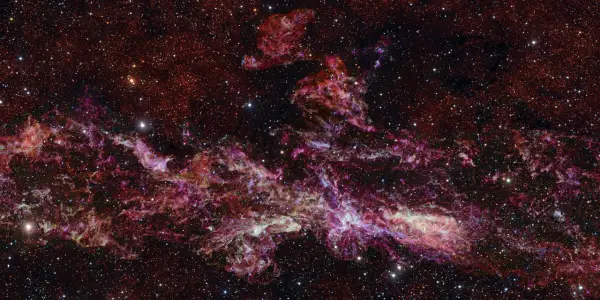
Researchers have identified erythrulose, a four-carbon sugar molecule, in interstellar space, raising questions about the origins of life.
In-depth analysis
New discoveries
Astronomers have made a significant breakthrough by identifying the sugar molecule erythrulose in interstellar space, marking the first detection of such a compound beyond Earth. This discovery enhances understanding of cosmic chemistry, potentially shedding light on the molecular precursors that contributed to the emergence of life, as detailed in the journal Nature.
Mission updates
The research team, led by Izaskun Jiménez Serra, successfully analyzed data from radio telescopes in Spain, revealing molecular signatures of erythrulose. This analysis represents a pivotal advancement in the study of organic compounds in the universe.
Who is affected
This discovery impacts the scientific community, particularly researchers focused on astrobiology and the origins of life. It also holds implications for the broader understanding of chemical processes in space, which could inform future explorations of extraterrestrial environments.
Next steps
Following this discovery, researchers aim to further investigate the conditions in molecular cloud G and explore the formation of other organic compounds in space. Continued collaboration among observatories will enhance insights into the chemical complexity of the universe.
Did you know?
Why we should care
The detection of erythrulose in interstellar space highlights the complexity of cosmic chemistry and its implications for the origins of life. This discovery is not just an academic novelty; it could reshape how we understand the potential for life elsewhere in the universe. For everyday people, it underscores our connection to the cosmos, suggesting that the building blocks of life may be more widespread than previously thought, sparking imagination and curiosity about what lies beyond our planet.
The universe's unsolved mystery
Despite significant progress in understanding cosmic chemistry, many questions remain about how organic molecules like erythrulose form and accumulate in space. The discovery raises intriguing possibilities: Are these molecules precursors to life, or do they play a different role in the cosmic narrative? The quest to decode the universe's chemistry is far from over, with each finding opening new avenues of inquiry into our existence.
The person who looks at the stars
Meet Clara, an aspiring astrobiologist who spends nights gazing at the stars from her small apartment in New Mexico. The recent discovery of erythrulose captivates her imagination, as she dreams of what it means for life beyond Earth. Clara recalls her childhood fascination with the night sky, inspired by tales of astronomers uncovering the universe's secrets. Each new finding fuels her passion, driving her to understand the chemistry that could lead to life in distant worlds. For her, this isn’t just a scientific breakthrough; it’s a reminder of the profound connections between the cosmos and her own journey, igniting hope that one day, she might contribute to unraveling these mysteries herself.
Expert Commentary

Lenovo's Legion Tab Gen 3 Sees Significant Black...
Potential Evidence of Dark Matter Emerges from...
Unraveling the Mysteries of Mars: Recent...
European Space Agency Unveils Stunning Radar...

OnePlus 15 vs. Samsung Galaxy S25 Plus: A Clash...
Astronomers Uncover Evidence of Aging Stars...
Webb Telescope Reveals Unprecedented Cosmic...
Astronomers Capture Unprecedented Black Hole...
Andromeda Galaxy's Impact on Its Satellite...
James Webb Space Telescope May Have Detected the...
Astronomers Discover Ancient White Dwarf Actively...
Portal Systems Aims to Revolutionize Spacecraft...
Blue Origin Faces Major Setback as New Glenn...
James Webb Space Telescope Captures Stunning...
Ancient Galaxies: A Chaotic Early Universe...
Meteorite Fragment May Have Impacted Houston Home
ISS Crew Takes Precautions Against Radiation...
NASA Unveils New Images of Interstellar Comet...
Study Suggests the Universe's Expansion May Be...
SabreSat: An Innovative Air-Breathing Satellite...

NASA's Artemis 3 Moon Mission Delayed to 2028 Due...

Foundation Season 3 Hints at Deeper Asimov Themes...
Young Canadian Astronomer Identifies Two...
Breakthrough in Milky Way Simulation Using AI...
NASA and European Partners Prepare for...
NASA's Ambitious Timeline for Human Exploration...
AI Reveals Over 800 New Cosmic Anomalies from...
New Simulations Shed Light on the Enigmatic...
Euclid Space Telescope Discovers Hidden Stars in...
The Pleiades Star Cluster Reveals Its Extensive...
Exploring Oregon's Premier Public Telescope...
Hawaiian Students Honor Gemini North Telescope's...
NASA Advances Artemis 2 Mission with Orion...

Samsung Unveils Unprecedented Black Friday Deal...
Potential Alien Disclosure May Trigger Bitcoin...
Astrophysicists Unveil Dark Universe Through...
Astronomers Uncover a Rapid Star-Forming Galaxy...
Assessing the Financial Impact of NASA's Apollo...

Childcare Crisis: Families Struggle as...
James Webb Space Telescope Sheds Light on Early...