James Webb Space Telescope Sheds Light on Early Supermassive Black Holes
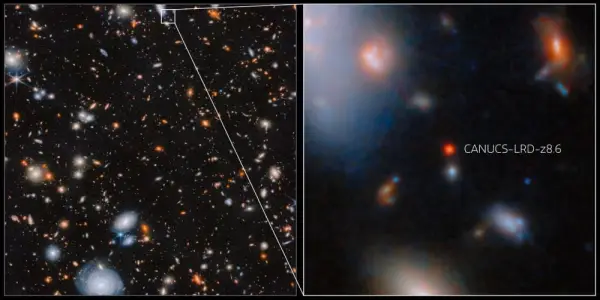
New findings from the James Webb Space Telescope reveal an actively growing supermassive black hole in a galaxy formed just 570 million years after the Big Bang, challenging existing theories about black hole formation in the early universe.
In-depth analysis
New discoveries
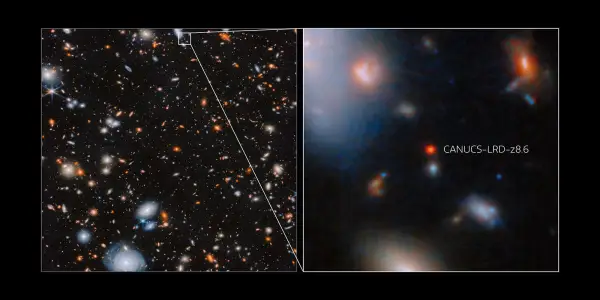
The James Webb Space Telescope has identified a supermassive black hole in the galaxy CANUCS-LRD-z8, emerging just 570 million years after the Big Bang. This finding challenges existing astrophysical models, indicating that SMBHs may develop much earlier than previously thought, and provides vital insights into the formation of galaxies in the universe's infancy.
Mission updates
The JWST continues to deliver groundbreaking data, with its NIRSpec instrument playing a key role in observing the spectral features of the active black hole in CANUCS-LRD-z8, enhancing our understanding of early cosmic structures.
Who is affected
This discovery impacts astronomers and astrophysicists who study galaxy formation and black hole evolution. It challenges current theories and prompts researchers to reconsider the timeline and mechanisms behind the emergence of supermassive black holes in the early universe.
Next steps
Following this discovery, researchers plan to conduct further observations with JWST and future telescopes to explore cold gas in early galaxies. This research aims to clarify the relationship between black holes and galaxy formation during the universe's formative years.
Did you know?
Why we should care
The discovery of a supermassive black hole just 570 million years after the Big Bang reshapes our understanding of cosmic evolution. This revelation challenges established theories, prompting a reevaluation of how galaxies and black holes formed. For everyday life, it underscores the intricate connections between astronomical phenomena and fundamental questions about the universe, sparking curiosity and inspiring the next generation of scientists.
The universe's unsolved mystery
The existence of supermassive black holes so soon after the Big Bang remains an enigma in astrophysics. This discovery invites a deeper examination of black hole formation processes, challenging current models and expanding our comprehension of cosmic history. Unraveling this mystery could redefine our understanding of the universe's structure and evolution.
The person who looks at the stars
Meet Clara, a 12-year-old aspiring astronomer from a small town. Every night, she sets up her telescope in her backyard, peering into the cosmos with wonder. The news of a supermassive black hole emerging just 570 million years after the Big Bang ignites her imagination. Clara dreams of becoming a scientist to unlock the mysteries of the universe. For her, the stars aren't just distant points of light; they represent a vast playground of possibilities. The excitement surrounding the James Webb Space Telescope's discoveries fuels her passion, making her believe that one day, she too could contribute to our understanding of the universe's origins.

Samsung Galaxy S26 Expected to Feature Enhanced...
X5.1 Solar Flare Triggers G4 Geomagnetic Storm...
James Webb Space Telescope Captures Stunning...
Hawaiian Students Honor Gemini North Telescope's...
SpaceX Faces Challenges in Meeting NASA's 2027...
Rogue Moons: A New Frontier for Life Beyond Stars
Congress Questions NASA's Facility Closures Amid...

Discovery of a Planet Formation Zone Beyond...

Innovative Portable Reflecting Telescope...
Astronomers Discover Ancient White Dwarf Actively...
China's Mars Orbiter Captures Image of...
Unusual Wind from Neutron Star Challenges Space...

Urwerk Unveils Limited-Edition 100V 'LightSpeed'...

NASA's Artemis 3 Moon Mission Delayed to 2028 Due...

Daily Roundup: November 10, 2025 – Advancements...

Exploring Alternatives to the Meta Quest 3 Elite...
Potential Alien Disclosure May Trigger Bitcoin...
Italian Producer Plans Historic Film to Shoot in...

Deep Fission Proposes Underground Nuclear...

This Week In Space Podcast: Episode 187 Explores...
James Webb Telescope Identifies Rapidly Growing...
New Research Suggests Dark Matter Influences...
New Simulations Shed Light on the Enigmatic...

Enhance Your Weather Preparedness with Weather...
Webb Telescope Reveals Unprecedented Cosmic...

Childcare Crisis: Families Struggle as...
Euclid Space Telescope Discovers Hidden Stars in...
New Mexico Startup Unveils Ambitious Plan to...
Exploring the Composition of Cosmic Voids

Unistellar eQuinox 2 Smart Telescope Sees...
NASA Advances Artemis 2 Mission with Orion...

Foundation Season 3 Hints at Deeper Asimov Themes...
Ancient Galaxies: A Chaotic Early Universe...
Recent Studies Explore Potential Exoplanet in...
Astronomers Identify Potential Earth-Like...
Intense Solar Storm May Illuminate Skies Across...

Samsung Unveils Unprecedented Black Friday Deal...
NASA and Blue Origin Successfully Launch Dual...