China's Mars Orbiter Captures Image of Interstellar Comet 3I/ATLAS

China's Mars orbiter Tianwen-1 captures a stunning image of interstellar comet 3I/ATLAS, marking a significant milestone in space exploration and discovery.
In-depth analysis
New discoveries
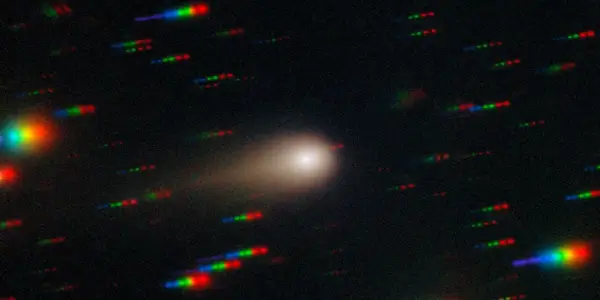
China's Tianwen-1 Mars orbiter has successfully captured an image of interstellar comet 3I/ATLAS, marking a significant advancement in space exploration. This comet, originating from outside the solar system, is only the third of its kind documented, following 1I/Oumuamua and 2I/Borisov. Its unique trajectory and rapid movement enhance our understanding of interstellar objects.
Mission updates
The China National Space Administration has announced a delay in the Shenzhou spacecraft's return, initially set for November 5, due to damage from space debris. A comprehensive impact analysis is underway to ensure astronaut safety.
Who is affected
The astronauts aboard the Shenzhou spacecraft are directly impacted by the delay caused by space debris damage. Additionally, the incident raises concerns for space agencies globally, highlighting the ongoing risks associated with increasing space traffic and debris management.
Next steps
CNSA will conduct a thorough analysis to assess the damage and ensure the safety of the crew aboard the Shenzhou spacecraft. Future missions may also incorporate enhanced measures to mitigate risks from space debris.
Did you know?
Why we should care
The successful imaging of interstellar comet 3I/ATLAS signifies a leap in humanity's understanding of the cosmos. For everyday people, this achievement means a deeper connection to the universe and a reminder of our place within it. As scientists gather data about such objects, we gain insights that could inform future space missions, improve technology, and perhaps one day address the potential risks of interstellar threats.
The universe's unsolved mystery
Comets like 3I/ATLAS raise profound questions about the origins of our solar system and the materials that may travel between stars. Their unpredictable trajectories challenge our understanding of celestial mechanics and the formation of planetary systems. As we capture images of these distant wanderers, we're reminded that much of the universe remains a puzzle, waiting for inquisitive minds to unlock its secrets.
The person who looks at the stars
Meet Sofia Chen, a 12-year-old aspiring astronomer from Beijing. Ever since she was gifted a telescope for her birthday, Sofia has spent countless evenings gazing at the night sky, captivated by the stories written in the stars. The news of China capturing an image of 3I/ATLAS fills her with excitement and inspiration. Sofia dreams of contributing to space exploration one day, believing that understanding these interstellar visitors can help humanity prepare for the future. For her, each comet is not just a fleeting glimpse of the cosmos but a potential key to unlocking the mysteries of existence. As she watches the stars, Sofia feels a connection to the universe that fuels her curiosity and passion for discovery.
Innovative Portable Reflecting Telescope...
Enhance Your Weather Preparedness with Weather...
Highlights of 2025 in Space Exploration: From...
China's Mars Orbiter Captures Image of...
Rogue Moons: A New Frontier for Life Beyond Stars
NASA's X-59 Achieves Historic Supersonic Flight

Childcare Crisis: Families Struggle as...
X5.1 Solar Flare Triggers G4 Geomagnetic Storm...

Samsung's Galaxy S26 Ultra Set for Significant...
Jupiter's Moons Io and Europa to Cast Shadows...
Boeing's Upcoming Starliner Mission Set for April...
Potential Evidence of Dark Matter Emerges from...

Foundation Season 3 Hints at Deeper Asimov Themes...
India Successfully Launches CMS-03 Military...
Recent Studies Explore Potential Exoplanet in...

Astronomers Uncover a Rapid Star-Forming Galaxy...
Astronomers Converge in Phoenix for AAS 247: A...
Breakthrough in Milky Way Simulation Using AI...
Samsung Galaxy S26 Expected to Feature Enhanced...

Top Black Friday Smartwatch Deals Worth...
SpaceX Faces Challenges in Meeting NASA's 2027...
Intense Solar Storm May Illuminate Skies Across...

NASA's Artemis 3 Moon Mission Delayed to 2028 Due...
SabreSat: An Innovative Air-Breathing Satellite...
James Webb Telescope Identifies Rapidly Growing...
Ancient Galaxies: A Chaotic Early Universe...
Exploring the Composition of Cosmic Voids
Intense Solar Storms Could Ignite Life on...
AI Reveals Over 800 New Cosmic Anomalies from...
Assessing the Financial Impact of NASA's Apollo...
NASA Advances Artemis 2 Mission with Orion...
Interstellar Comet 3I/ATLAS Approaches...
Astronomers Discover Ancient White Dwarf Actively...
New Research Suggests Dark Matter Influences...

Portal Systems Aims to Revolutionize Spacecraft...
Exploring Oregon's Premier Public Telescope...

OnePlus 15 vs. Samsung Galaxy S25 Plus: A Clash...
NASA's Ambitious Timeline for Human Exploration...