Jupiter's Moons Io and Europa to Cast Shadows Over the Gas Giant on November 5
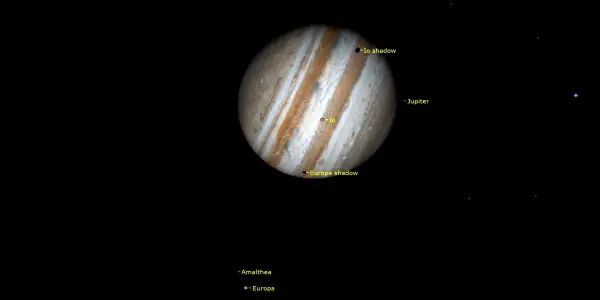
Observers can witness the shadows of Jupiter's moons Io and Europa crossing the planet's surface during a rare astronomical event in the early hours of November 5.
In-depth analysis
New discoveries
The upcoming shadow transit of Io and Europa on November 5 offers a unique opportunity to observe the gravitational interactions within Jupiter's extensive moon system. This event underscores the intricate dynamics at play among the 79 known moons, enhancing our understanding of planetary systems and their behaviors.
Mission updates
As the date approaches, astronomers are preparing to document the shadow transit of Jupiter's moons, which will be visible in the early morning sky. Observers are encouraged to utilize telescopes to fully appreciate this rare phenomenon.
Who is affected
Amateur astronomers and stargazers will benefit from this celestial event, as it provides a rare glimpse into the workings of Jupiter's moons. Additionally, educators and astronomy enthusiasts can use this opportunity to inspire interest in planetary science among students and the general public.
Next steps
Observers should prepare their telescopes and familiarize themselves with the timing of the transit. Engaging with smartphone astronomy apps may enhance the viewing experience, allowing for a deeper appreciation of this remarkable astronomical event.
Did you know?
Why we should care
This shadow transit of Io and Europa over Jupiter allows us to witness the remarkable dynamics of our solar system in real-time. For everyday stargazers, it’s more than just a visual treat; it’s a chance to connect with the cosmos. Such events inspire curiosity and deepen our understanding of celestial mechanics, making the universe feel closer and more accessible.
The universe's unsolved mystery
While the shadow transit showcases Jupiter's gravitational ballet, it also raises questions about the formation and evolution of its moons. How did Io and Europa develop their unique characteristics, and what secrets might they hold about the potential for life beyond Earth? Each observation brings us closer to unraveling these cosmic mysteries.
The person who looks at the stars
Meet Clara, a high school science teacher in a small town, whose passion for astronomy ignited during her childhood visits to a planetarium. Every night, she sets up her telescope in her backyard, hoping to ignite that same spark in her students. The upcoming shadow transit of Io and Europa is not just a spectacle for her; it's a teaching moment. As she prepares lesson plans around this event, she envisions her students gathering under the stars, eyes wide with wonder. For Clara, each shadow that crosses Jupiter's surface represents the stories of discovery and exploration that she hopes to pass on. It’s an opportunity to inspire the next generation of scientists, reminding them that the universe is full of mysteries waiting to be explored.
Andromeda Galaxy's Impact on Its Satellite...
Fintech Founder Champions Innovation Through...
Unistellar eQuinox 2 Smart Telescope Sees...
James Webb Space Telescope Captures Stunning...
Deep Fission Proposes Underground Nuclear...

Samsung Unveils Unprecedented Black Friday Deal...
Ancient Earth Chemistry Discovered Beneath Modern...
Breakthrough in Milky Way Simulation Using AI...
NASA's Ambitious Timeline for Human Exploration...
Discovery of a Planet Formation Zone Beyond...
Boeing's Upcoming Starliner Mission Set for April...
Hubble Telescope Unveils Enigmatic Galaxy NGC 2775
The Dwarf III Smart Telescope: A Compact Marvel...

Daily Roundup: November 10, 2025 – Advancements...
X5.1 Solar Flare Triggers G4 Geomagnetic Storm...
New Mexico Startup Unveils Ambitious Plan to...
Study Suggests the Universe's Expansion May Be...
James Webb Telescope Identifies Rapidly Growing...
Astronomers Uncover Evidence of Aging Stars...
SpaceX Achieves 150th Falcon 9 Launch with...
Webb Telescope Reveals Unprecedented Cosmic...
Euclid Space Telescope Discovers Hidden Stars in...
Hawaiian Students Honor Gemini North Telescope's...
Enhance Your Weather Preparedness with Weather...
Apple Introduces Emergency SOS via Satellite in...
NASA Considers Reopening Bidding for Artemis 3...
Astronomers Converge in Phoenix for AAS 247: A...
Innovative Portable Reflecting Telescope...
Exploring the Best Online Resources for Stunning...
Intense Solar Storm May Illuminate Skies Across...

X-Men Return to Education in Upcoming Comic...
Assessing the Financial Impact of NASA's Apollo...
Collaboration Between Exoplanet Researchers and...
NASA's Artemis 3 Moon Mission Delayed to 2028 Due...

Childcare Crisis: Families Struggle as...
India Successfully Launches CMS-03 Military...
Astronomers Capture Unprecedented Black Hole...
Young Canadian Astronomer Identifies Two...
China's Mars Orbiter Captures Image of...