New Insights into Gamma Ray Emissions Could Illuminate Dark Matter's Existence
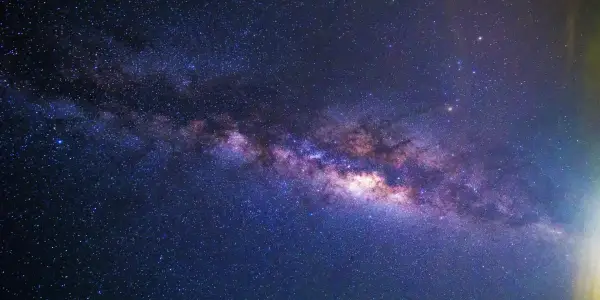
Researchers at Johns Hopkins University are investigating a mysterious gamma ray glow emanating from the Milky Way, potentially linked to dark matter interactions or the activity of millisecond pulsars.
In-depth analysis
New discoveries
Recent research from Johns Hopkins University has unveiled a mysterious gamma ray glow emanating from the Milky Way's center. This intriguing phenomenon could shed light on dark matter, suggesting it may arise from either dark matter particle collisions or emissions from millisecond pulsars, thus reigniting debates within the astrophysics community.
Mission updates
The research team is set to utilize the Cherenkov Telescope Array, a high-resolution gamma-ray telescope, to enhance detection capabilities and clarify the source of the gamma rays observed, whether from dark matter interactions or pulsar activity.
Who is affected
This research impacts astrophysicists and cosmologists worldwide, as understanding dark matter is crucial for comprehending the universe's structure and evolution. The findings may also influence future studies and models related to cosmic phenomena and the fundamental forces governing the universe.
Next steps
Moving forward, the team will analyze dwarf galaxies orbiting the Milky Way to refine predictions about dark matter distribution. This comparative study aims to either validate one of the existing theories or add further complexity to our understanding of dark matter.
Did you know?
Why we should care
Understanding dark matter could reshape our grasp of the universe and our place in it. This research may explain the very fabric of reality, influencing everything from the formation of galaxies to the stability of our own solar system. For everyday life, advancements in astrophysics can lead to breakthroughs in technology, such as improved imaging techniques or enhanced materials science, which may ultimately benefit various industries.
The universe's unsolved mystery
The gamma-ray glow at the center of our galaxy represents a tantalizing clue in the search for dark matter, a substance that makes up about 27% of the universe. Despite its significant presence, dark matter remains elusive, prompting questions about the fundamental nature of reality. Each new study, like this one, serves as a stepping stone toward uncovering the profound mysteries that govern our cosmos.
The person who looks at the stars
Meet Sarah, an amateur astronomer from a small town. Every clear night, she sets up her telescope, peering into the vastness of the Milky Way. For her, the recent discovery of a gamma-ray glow is more than scientific data; it’s a personal connection to the universe. Sarah dreams of a future where dark matter is no longer an enigma, hoping to inspire her students with the wonders of astrophysics. Each observation she makes feels like a conversation with the cosmos, a reminder of humanity's endless quest for understanding. As researchers delve deeper into this mystery, Sarah feels a sense of belonging to a larger narrative, one where her curiosity contributes to a greater understanding of the universe.
Discovery of a Planet Formation Zone Beyond...

NASA's X-59 Achieves Historic Supersonic Flight
Young Canadian Astronomer Identifies Two...

Jeff Bezos's AI Hardware Venture Takes Aim at...
Exploring the Best Online Resources for Stunning...

India Successfully Launches CMS-03 Military...
NASA Unveils New Images of Interstellar Comet...
Breakthrough in Milky Way Simulation Using AI...

Satellite Imagery Highlights Hurricane Damage...

Samsung Galaxy S26 Expected to Feature Enhanced...
Astronomers Discover Ancient White Dwarf Actively...
Euclid Space Telescope Discovers Hidden Stars in...
Andromeda Galaxy's Impact on Its Satellite...

Congress Questions NASA's Facility Closures Amid...
New Mexico Startup Unveils Ambitious Plan to...

X-Men Return to Education in Upcoming Comic...
Hubble Telescope Unveils Enigmatic Galaxy NGC 2775
NASA's Campaign to Monitor Interstellar Comet...
Fintech Founder Champions Innovation Through...
Interstellar Comet 3I/ATLAS Approaches...
Rogue Moons: A New Frontier for Life Beyond Stars

NASA's Ambitious Timeline for Human Exploration...

NASA and Blue Origin Successfully Launch Dual...

NASA's Artemis 3 Moon Mission Delayed to 2028 Due...
Astronauts aboard the ISS Capture Stunning Images...
X5.1 Solar Flare Triggers G4 Geomagnetic Storm...
James Webb Space Telescope Captures Stunning...
James Webb Telescope Identifies Rapidly Growing...
Recent Studies Explore Potential Exoplanet in...
The Pleiades Star Cluster Reveals Its Extensive...

OnePlus 15 vs. Samsung Galaxy S25 Plus: A Clash...

Enhance Your Weather Preparedness with Weather...
Mapping the Invisible: Astronomers Uncover Dark...
China's Mars Orbiter Captures Image of...

Unistellar eQuinox 2 Smart Telescope Sees...

Meteorite Fragment May Have Impacted Houston Home
Russian Cosmonauts Conduct Extended Spacewalk to...

Deep Fission Proposes Underground Nuclear...