Cataloging 40,000 Near-Earth Asteroids: A Milestone in Planetary Defense
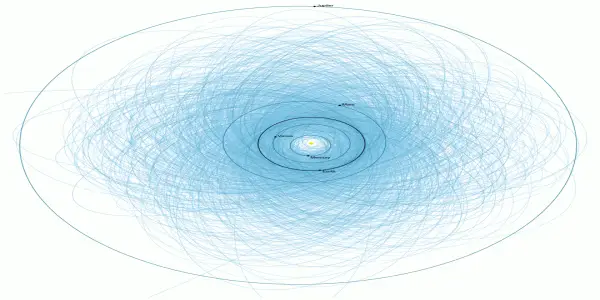
The recent identification of the 40,000th near-Earth asteroid underscores humanity's proactive stance in planetary defense against potential cosmic threats. These celestial objects vary widely in size and pose different levels of risk to Earth.
In-depth analysis
New discoveries
The cataloging of the 40,000th near-Earth asteroid signifies a transformative moment in celestial research. This milestone highlights the rapid advancements in detection technologies, allowing astronomers to systematically track and analyze these objects. The discovery rate has surged, particularly with the aid of specialized telescopes, enhancing our understanding of their trajectories and potential threats.
Mission updates
The ESA's Hera mission is currently progressing toward the asteroid Didymos, focusing on testing planetary defense strategies. This initiative is part of a larger international collaboration aimed at improving our knowledge and preparedness regarding near-Earth objects.
Who is affected
The ongoing research into near-Earth asteroids impacts a wide range of stakeholders, including space agencies, scientists, and global communities. Enhanced monitoring and understanding of these asteroids are crucial for mitigating potential threats that could affect millions of lives and ecosystems worldwide.
Next steps
Future efforts will prioritize the identification of smaller near-Earth asteroids, as current estimates indicate that only 20% have been cataloged. Continued investment in advanced observational technologies will be essential for improving detection capabilities and ensuring planetary safety.
Did you know?
Why we should care
The cataloging of 40,000 near-Earth asteroids is more than an astronomical achievement; it directly impacts global safety. With many asteroids lurking close to our planet, understanding their trajectories can help us prepare for possible threats. This knowledge could influence everything from urban planning to emergency preparedness, making it vital for communities to stay informed about cosmic events that could alter life on Earth.
The universe's unsolved mystery
Despite cataloging 40,000 near-Earth asteroids, a significant number remain hidden, particularly the smaller ones. Each undiscovered asteroid represents not just a potential threat but also an opportunity for scientific discovery. Understanding their origins could unlock secrets about the solar system's formation and evolution, paving the way for breakthroughs in both planetary science and our understanding of life's beginnings.
The person who looks at the stars
Meet Dr. Maria Chen, a passionate astrophysicist who spends her nights at the observatory in Chile, peering through telescopes at the vast expanse of space. For Maria, each newly discovered asteroid feels personal; it connects her to a greater mission of protecting humanity. As she tracks these celestial bodies, she reflects on her childhood dreams of exploring the universe. Now, her work is not just about discovery but about safeguarding her young son’s future. The weight of her responsibility drives her, knowing that her findings could prevent a potential catastrophe. Maria embodies the intersection of science and human emotion, reminding us that the cosmos is not just a distant frontier, but a crucial part of our everyday existence.

Portal Systems Aims to Revolutionize Spacecraft...

Meteorite Fragment May Have Impacted Houston Home

Enhance Your Weather Preparedness with Weather...
James Webb Telescope Identifies Rapidly Growing...
Unusual Wind from Neutron Star Challenges Space...
SabreSat: An Innovative Air-Breathing Satellite...
Interstellar Comet 3I/ATLAS Approaches...
X5.1 Solar Flare Triggers G4 Geomagnetic Storm...

China's Mars Orbiter Captures Image of...
NASA Advances Artemis 2 Mission with Orion...
Unraveling the Mysteries of Mars: Recent...
ISS Crew Takes Precautions Against Radiation...
Intense Solar Storm May Illuminate Skies Across...
Astronauts aboard the ISS Capture Stunning Images...
Ancient Galaxies: A Chaotic Early Universe...

Deep Fission Proposes Underground Nuclear...

FULU Foundation Introduces Repair Bounty System...
James Webb Space Telescope Captures Stunning...

This Week In Space Podcast: Episode 187 Explores...
Assessing the Financial Impact of NASA's Apollo...
India Successfully Launches CMS-03 Military...
NASA and Blue Origin Successfully Launch Dual...

NASA's Artemis 3 Moon Mission Delayed to 2028 Due...
James Webb Space Telescope Discovers Ancient...
SpaceX Achieves 150th Falcon 9 Launch with...
Recent Studies Explore Potential Exoplanet in...
Highlights of 2025 in Space Exploration: From...
Italian Producer Plans Historic Film to Shoot in...
Astrophysicists Unveil Dark Universe Through...

European Space Agency Unveils Stunning Radar...
Astronomers Uncover a Rapid Star-Forming Galaxy...

Artemis 2 Astronauts Safely Return After Historic...
AI Reveals Over 800 New Cosmic Anomalies from...
James Webb Space Telescope Sheds Light on Early...


Childcare Crisis: Families Struggle as...
Astrophotographer Captures Stunning Image of...
Apple Introduces Emergency SOS via Satellite in...
New Simulations Shed Light on the Enigmatic...

Samsung Unveils Unprecedented Black Friday Deal...