Colombia's ELN Rebels Intensify Military Drills Amid Rising Tensions with Trump Administration
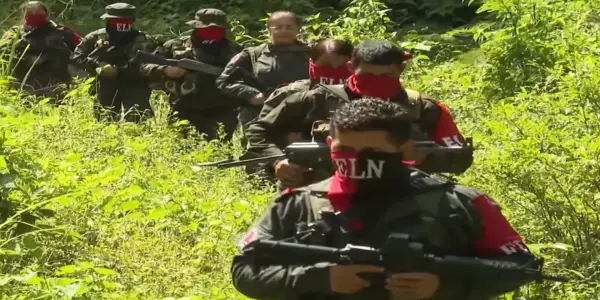
Colombia's ELN rebels launch a three-day civilian lockdown for military drills amid rising tensions with the Trump administration, raising concerns over secu...
In-depth analysis
Background context
Colombia's National Liberation Army (ELN), the largest remaining guerrilla group in the country, has imposed a three-day civilian lockdown to conduct military drills. This directive follows escalating tensions with the United States, particularly after former President Trump's strong warnings about military action against nations involved in drug production, including Colombia.
Key political implications
The ELN's actions and Trump's aggressive stance signal a potential escalation in U.S. military involvement in Colombia, complicating the already fragile peace process and impacting bilateral relations.
Who gains / who loses
The ELN may consolidate its control and instill fear among civilians, reinforcing its authority in drug-producing regions. Conversely, the Colombian government faces increased challenges to its legitimacy and security, while the U.S. risks further destabilizing the region through military posturing.
Possible future scenarios
If tensions continue to rise, Colombia may experience intensified military actions from both the ELN and the U.S., potentially leading to greater violence. Alternatively, diplomatic efforts could emerge if both sides seek to de-escalate the situation.
Did you know?
Why you should know this
The ELN's military lockdown highlights the precarious balance between security and civilian life in Colombia. For residents, this means disrupted daily routines, with the looming threat of violence impacting access to food, education, and essential services. As U.S. pressure mounts on Colombia regarding drug production, this situation serves as a stark reminder of how international politics can directly affect everyday lives, particularly in conflict-ridden regions.
Behind the political curtain
The ELN has a surprising historical connection to Colombia’s Catholic Church, which once provided a platform for peace talks in the 1990s. Despite its armed activities, the group has often framed its narrative around social justice, complicating the perception of guerrilla warfare in the nation.
Ordinary person in an extraordinary situation
Maria, a 34-year-old teacher in Catatumbo, has always dreamed of a peaceful Colombia for her children. As the ELN enforces a lockdown, her school is forced to close, leaving her students without education and her family struggling to find food amidst the chaos. Maria feels the weight of fear and uncertainty intensifying; she worries about how these military drills will shape her community's future. The tension between the ELN and U.S. policies looms large in her daily life, making her question if the dream of a peaceful Colombia will ever be realized. Maria’s plight underscores the human cost of geopolitical conflicts, revealing how policies made thousands of miles away deeply affect the lives of ordinary Colombians.
Expert Commentary
Frankly, this is terrifying. The U.S. is threatening to bomb a country into submission over drugs, and the guerrillas are locking down villages to prepare for war. Meanwhile, civilians are just caught in the middle—again. Trump telling Petro he’ll be “next” isn’t diplomacy; it’s a threat. And the ELN warning not to “wake the jaguar”? That’s not bravado—that’s a promise. Colombia has suffered enough. We don’t need another forever war dressed as anti-drug policy.
Mark Carney Discusses Political Transition During...
Sanae Takaichi Poised to Become Japan's First...
Japan and Finland in Diplomatic Tension Following...

Reddit Enhances App Performance with R8...
Six Finalists Announced for the 2026...

Spain's Attorney General Convicted in...
Analyzing Trump's Latin America Strategy Amid...
Trump Addresses Nuclear Testing, Government...
Russian and Indian Foreign Ministers Convene...
UK Finalizes £8 Billion Typhoon Fighter Jet...
Lessons from Ulysses S. Grant on Civil-Military...

The Evolving Landscape of Copyright Enforcement...
Misjudgments in Military Strategy: The Lessons...

European Automakers Face New Chip Shortage as...
U.S. Extends Sanctions Relief as Syrian Leader...
Canada and China Take Steps Toward Repairing...
Colombia's ELN Rebels Intensify Military Drills...
Zohran Mamdani Secures Victory in New York City...
Javier Milei's Victory Signals a Shift in...

WWE Raw Recap: Titles Change Hands in Thrilling...

Mamdani Emerges Victorious in NYC Mayoral Race...

Exploring Intimacy and Isolation in Claire-Louise...
Indian Trade Unions Rally Against New Labour...
Khamenei Assassination: A Pivotal Shift in...
The Impact of Trump's Second Year: A Year of...
Jim Avila, Esteemed ABC News Correspondent, Dies...
Democrats Celebrate Recent Wins Amidst Internal...
Tarique Rahman's Homecoming: A Potential Turning...


Political Reactions to BBC Leadership Changes...
Japan Reacts Strongly to China's Travel Advisory...
Algeria Grants Pardon to Jailed Novelist Boualem...
South Korea Rebuilds Trust and Reassesses Foreign...
Saudi Crown Prince Mohammed bin Salman Set for...

AfD Leader Raises Concerns Over Potential Threats...
Canada Decides Against Public Disclosure of Nazi...

Golden Snub-Nosed Monkeys Make European Debut in...
Trump Appoints Special Envoy to Greenland,...
The 1969 Sino-Soviet Border Conflict: A Near Miss...
U.S. Lawmakers Express Concerns Over Trump...