Mali's Military Government Restructures Following Coordinated Attacks by Armed Groups
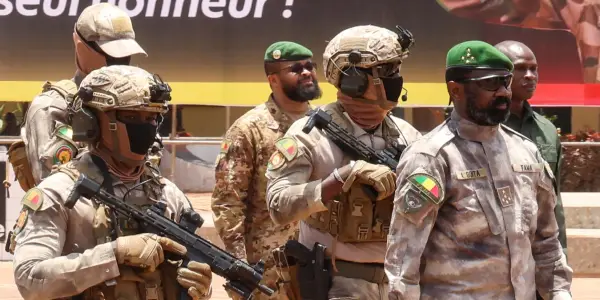
In the wake of recent attacks, Mali's military leadership has assumed new roles while the country grapples with escalating violence and humanitarian crises.
In-depth analysis
Background context
Mali has faced persistent security challenges since the 2012 Tuareg rebellion, which destabilized the northern regions. The recent coordinated attacks by JNIM represent a critical escalation in violence, raising concerns about national stability and the effectiveness of the military government established after the 2020 coup amid widespread dissatisfaction with previous governance.
Key political implications
The restructuring of Mali's military government signals a potential shift in power dynamics, as the new defense minister may influence military strategies and alliances, particularly regarding the involvement of foreign mercenaries.
Who gains / who loses
The Wagner Group may gain influence by positioning itself as a key ally of the Malian military, while local populations suffer due to increased violence and humanitarian crises, risking further alienation from their government.
Possible future scenarios
As military operations intensify, Mali could either see a temporary suppression of armed groups or a deepening of the conflict, with the potential for increased civilian casualties and a humanitarian crisis if swift action is not taken.
Did you know?
Why you should know this
The ongoing violence in Mali affects global security and humanitarian efforts. As armed factions gain influence, the stability of the Sahel region becomes precarious, impacting international trade, migration patterns, and counterterrorism initiatives. Understanding Mali's crisis sheds light on broader geopolitical tensions and the urgent need for humanitarian aid, especially for civilians facing starvation amid escalating conflict.
Behind the political curtain
Assimi Goita, Mali's military leader, was a key figure in the 2020 coup that ousted the previous government. What’s less known is that his rise to power was fueled not just by anti-jihadist sentiments, but also by widespread public discontent over corruption and ineffective governance that preceded the insurgency.
Ordinary person in an extraordinary situation
In the town of Diafarabe, Amina, a 32-year-old mother of three, wakes up each day to the sound of distant gunfire. With food supplies dwindling and her children increasingly anxious, she spends hours searching for ways to secure their next meal. Amina has become a community leader, organizing local women to share resources and support each other amid the chaos. Her resilience exemplifies how ordinary citizens are navigating this extraordinary crisis, working to protect their families while confronting the harsh realities of insecurity and poverty. Amina's story reflects the profound human cost of conflict, reminding us that behind every statistic is a family facing unthinkable challenges.
Expert Commentary
Canada and China Take Steps Toward Repairing...
Geopolitical Tensions Surround Palau Amid...
Canada Decides Against Public Disclosure of Nazi...
Political Reactions to BBC Leadership Changes...

Mark Carney Discusses Political Transition During...

Bhutan's Complex Relationship with India: A...

Misjudgments in Military Strategy: The Lessons...

Golden Snub-Nosed Monkeys Make European Debut in...
Italy's Meloni Engages with Qatar Emir on Energy...
Denmark's Prime Minister Advocates for Stricter...

New England Senators Play Crucial Role in...
Canada's Carney to Meet Xi in China, Signaling a...

Challenges Faced by Costumes in 'Mighty Morphin...
Germany Resumes Arms Exports to Israel Amid...

Mamdani Emerges Victorious in NYC Mayoral Race...

Isaac Asimov's Perspective on Star Trek: A Sci-Fi...
Khamenei Assassination: A Pivotal Shift in...

New Yorkers Kick Off Early Voting for Mayoral...

Revitalizing Relations: The Future of the...
Exiled Russian Orthodox Leader Responds to Spying...
Sias University Adapts to Modern Educational...
Is the U.S. Reassessing Its Stance on Israel...

Jetpack Navigation 3 Achieves Stability for...

Trump Appoints Special Envoy to Greenland,...

Spain's Attorney General Convicted in...
South Korea Rebuilds Trust and Reassesses Foreign...
Six Finalists Announced for the 2026...
Syria's Foreign Minister Visits China to...

NASA Unveils Stunning Images of Interstellar...
US Tariffs Impact Nuevo Leon's Steel Sector,...

Baden Bower Reduces Pitch-to-Publish Timeline by...
Egypt Affirms Commercial Nature of Gas Agreement...
Bangladesh's International Crimes Tribunal...

Ireland Moves Forward with Bill Targeting Israeli...
Indian Trade Unions Rally Against New Labour...
Russian and Indian Foreign Ministers Convene...

The Rise of Technocracy in Modern Governance

Algeria Grants Pardon to Jailed Novelist Boualem...
Cuba Rejects U.S. Security Threat Claims Amid...
The Impact of Trump's Second Year: A Year of...