Astronomers Capture First Image of Two Orbiting Black Holes
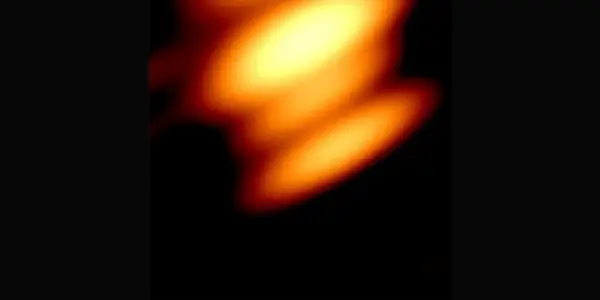
Astronomers unveil the first image of two supermassive black holes in quasar OJ287, confirming a key theoretical prediction and advancing our understanding o...
In-depth analysis
New discoveries
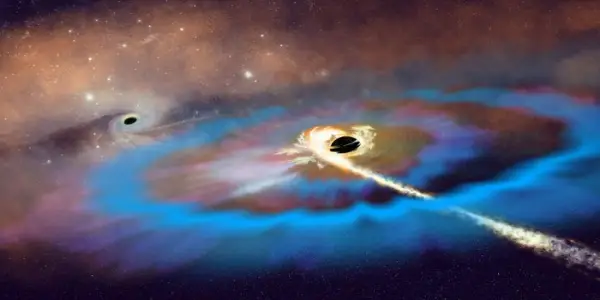
Astronomers have unveiled the first image of two supermassive black holes in gravitational interaction at quasar OJ287, confirming a long-theorized concept. This significant breakthrough not only enhances understanding of black hole dynamics but also sheds light on the formation processes of galaxies, demonstrating the complex relationships between these massive entities and their surroundings.
Mission updates
The recent findings stem from advanced radio observations utilizing Earth-based telescopes and a Russian satellite, which provided unprecedented resolution. These observations have validated the existence of dual black holes within OJ287, marking a pivotal moment in observational astrophysics.
Who is affected
This discovery impacts the scientific community, particularly astronomers and astrophysicists focused on black hole research. It also has broader implications for our understanding of galactic evolution, influencing future studies on the interactions between supermassive black holes and their host galaxies.
Next steps
Researchers plan to continue monitoring OJ287 to observe the motion of the smaller black hole as it completes its 12-year orbit. This ongoing study aims to deepen insights into black hole behavior and their dynamic interactions within galactic cores.
Did you know?
Why we should care
The discovery of two supermassive black holes in quasar OJ287 is more than an astronomical milestone; it impacts our understanding of the universe's formation. This knowledge may influence technologies we rely on daily, from satellite communications to the principles of energy generation. As researchers decode these cosmic phenomena, they unveil the underlying mechanics that shape galaxies, potentially guiding future innovations.
The universe's unsolved mystery
Despite progress in capturing images of black holes, many questions remain about their formation and influence on galaxy evolution. The gravitational interactions between supermassive black holes, like those in OJ287, may hold keys to understanding the universe's infancy and the nature of dark matter, challenging scientists to further unravel these cosmic enigmas.
The person who looks at the stars
Meet Elena, a 12-year-old aspiring astrophysicist from a small town. Every night, she gazes at the stars through her family’s old telescope, dreaming of discovering new worlds. The image of the two black holes in quasar OJ287 ignites her imagination, making her feel connected to the cosmos in a profound way. For Elena, this discovery isn't just a scientific breakthrough; it's a spark that fuels her passion for exploration. She envisions a future where she, too, might contribute to deciphering the mysteries of the universe. The story of OJ287 inspires her to believe that the impossible can become reality, and that her dreams of unveiling the universe's secrets are attainable.
Expert Commentary

Samsung Galaxy S26 Expected to Feature Enhanced...
X5.1 Solar Flare Triggers G4 Geomagnetic Storm...

Exploring Alternatives to the Meta Quest 3 Elite...
NASA's X-59 Achieves Historic Supersonic Flight

Samsung's Galaxy S26 Ultra Set for Significant...

Unistellar eQuinox 2 Smart Telescope Sees...
NASA's Campaign to Monitor Interstellar Comet...
New Mexico Startup Unveils Ambitious Plan to...

Satellite Imagery Highlights Hurricane Damage...
New Insights into Gamma Ray Emissions Could...
India Successfully Launches CMS-03 Military...
Portal Systems Aims to Revolutionize Spacecraft...
Interstellar Comet 3I/ATLAS Approaches...

FULU Foundation Introduces Repair Bounty System...

NASA's Artemis 3 Moon Mission Delayed to 2028 Due...

X-Men Return to Education in Upcoming Comic...
Astronauts aboard the ISS Capture Stunning Images...
Fintech Founder Champions Innovation Through...
Andromeda Galaxy's Impact on Its Satellite...
Study Suggests the Universe's Expansion May Be...
Mapping the Invisible: Astronomers Uncover Dark...
Boeing's Upcoming Starliner Mission Set for April...
AI Reveals Over 800 New Cosmic Anomalies from...
Intense Solar Storm May Illuminate Skies Across...
Ancient Galaxies: A Chaotic Early Universe...

Enhance Your Weather Preparedness with Weather...

Samsung Unveils Unprecedented Black Friday Deal...
The Impact of Space Technology on Everyday Life
Congress Questions NASA's Facility Closures Amid...

Jeff Bezos's AI Hardware Venture Takes Aim at...
Unusual Wind from Neutron Star Challenges Space...
Euclid Space Telescope Discovers Hidden Stars in...
Artemis 2 Astronauts Safely Return After Historic...
Potential Evidence of Dark Matter Emerges from...
Exploring the Composition of Cosmic Voids
Breakthrough in Milky Way Simulation Using AI...
Astronomers Capture Unprecedented Black Hole...
Unraveling the Mysteries of Mars: Recent...
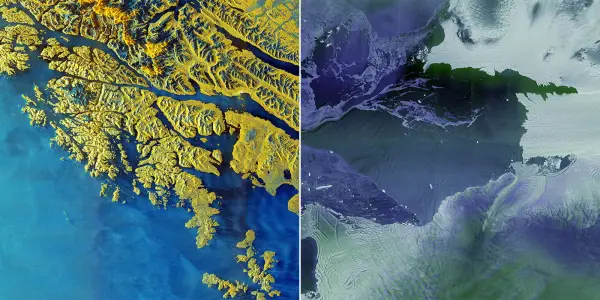
European Space Agency Unveils Stunning Radar...