Hubble Captures Stunning 'Starburst Ring' in NGC 6951
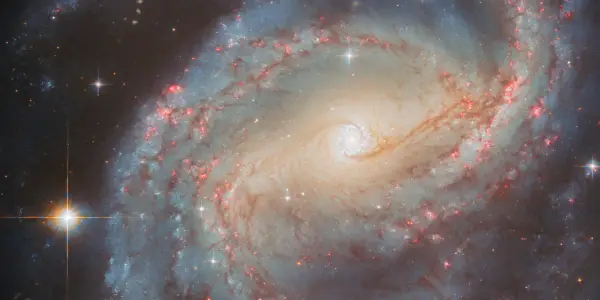
NASA's Hubble Space Telescope captures a breathtaking image of NGC 6951, showcasing a vibrant starburst ring formed by intense star activity in this dynamic ...
In-depth analysis
New discoveries
The Hubble Space Telescope has unveiled a stunning image of NGC 6951, a barred spiral galaxy notable for its dynamic stellar activity. The central bar structure serves as a conduit for gas, promoting the formation of a starburst ring approximately 3,000 light-years from the core, where new stars are rapidly forming.
Mission updates
Hubble's recent observations of NGC 6951 highlight its ongoing contributions to our understanding of galaxy evolution and star formation processes, particularly in regions exhibiting intense stellar activity.
Who is affected
Astronomers and astrophysicists are significantly impacted by Hubble's findings, as they provide critical insights into the lifecycle of galaxies. The knowledge gained from studying NGC 6951 aids in understanding broader cosmic phenomena and the mechanisms behind star formation.
Next steps
Future research will focus on analyzing additional data from Hubble to deepen the understanding of NGC 6951’s structure and star formation processes, as well as exploring similar galaxies to compare evolutionary patterns.
Did you know?
Why we should care
Understanding galaxies like NGC 6951 helps illuminate the mechanisms behind star formation and the evolution of the universe. These cosmic processes influence the very elements that make up our world—like oxygen and carbon. Such knowledge can deepen our appreciation for the universe's history, connecting us to the stars we see in the night sky and the atoms in our bodies.
The universe's unsolved mystery
Despite advancements in astronomy, the precise mechanisms behind star formation in regions like NGC 6951 remain enigmatic. Questions linger about the role of dark matter and how it interacts with visible matter to influence galaxy evolution. Each new discovery raises further inquiries, emphasizing the vastness of our ignorance about the cosmos.
The person who looks at the stars
Meet Sarah, a high school science teacher in a small town. Every night, she takes her telescope to the park, sharing her love for astronomy with her students and neighbors. When she gazes at NGC 6951, she imagines the thousands of stars being born, hoping to inspire curiosity in the next generation. For Sarah, these distant galaxies represent not just cosmic phenomena, but the limitless potential of human discovery. Her passion ignites conversations about our universe's mysteries, fostering a sense of wonder that transcends everyday life. As she teaches her students about the processes that create stars, she instills a deeper appreciation for science, encouraging them to chase their own dreams of exploration.

Urwerk Unveils Limited-Edition 100V 'LightSpeed'...
India Successfully Launches CMS-03 Military...

European Space Agency Unveils Stunning Radar...
Andromeda Galaxy's Impact on Its Satellite...
NASA's X-59 Achieves Historic Supersonic Flight
Euclid Space Telescope Discovers Hidden Stars in...

FULU Foundation Introduces Repair Bounty System...
Rogue Moons: A New Frontier for Life Beyond Stars
James Webb Space Telescope Captures Stunning...
Unraveling the Mysteries of Mars: Recent...

NASA's Artemis 3 Moon Mission Delayed to 2028 Due...

Apple Introduces Emergency SOS via Satellite in...

Samsung's Galaxy S26 Ultra Set for Significant...

Top Black Friday Smartwatch Deals Worth...
Discovery of a Planet Formation Zone Beyond...
The Pleiades Star Cluster Reveals Its Extensive...
Congress Questions NASA's Facility Closures Amid...
Boeing's Upcoming Starliner Mission Set for April...
NASA Considers Reopening Bidding for Artemis 3...
Recent Studies Explore Potential Exoplanet in...

Satellite Imagery Highlights Hurricane Damage...
Study Suggests the Universe's Expansion May Be...
Intense Solar Storms Could Ignite Life on...
China's Mars Orbiter Captures Image of...
Astronomers Capture Unprecedented Black Hole...
Assessing the Financial Impact of NASA's Apollo...

Foundation Season 3 Hints at Deeper Asimov Themes...
Charlotte: The Lunar 3D Printer Poised to...
New Research Suggests Dark Matter Influences...
X5.1 Solar Flare Triggers G4 Geomagnetic Storm...
Highlights of 2025 in Space Exploration: From...
NASA's ESCAPADE Probes Set for Unique Journey to...
Blue Origin Faces Major Setback as New Glenn...

Unusual Wind from Neutron Star Challenges Space...
Potential Evidence of Dark Matter Emerges from...
James Webb Space Telescope May Have Detected the...
Astrophysicists Unveil Dark Universe Through...
Astronomers Identify Three Earth-Sized Exoplanets...
Portal Systems Aims to Revolutionize Spacecraft...