Hubble Space Telescope Reveals Insights into Low Surface Brightness Galaxy NGC 45
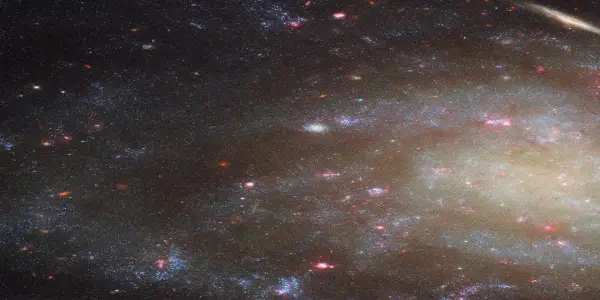
Recent observations from the Hubble Space Telescope provide a detailed view of the spiral galaxy NGC 45, located 22 million light-years away in the constellation Cetus, shedding light on its unique characteristics and the nature of star formation within it.
In-depth analysis
New discoveries
Recent observations by the Hubble Space Telescope have unveiled the spiral galaxy NGC 45, located about 22 million light-years away. This galaxy, classified as a low surface brightness galaxy, offers unique insights into star formation processes and the distribution of dark matter, contributing significantly to our understanding of galaxy evolution.
Mission updates
The Hubble Space Telescope continues its mission to explore nearby galaxies, with recent efforts focusing on capturing detailed images across various wavelengths, including ultraviolet and near-infrared.
Who is affected
Astronomers and astrophysicists are particularly impacted by these findings, as they provide critical data for studying galaxy formation and evolution. This research also enhances our understanding of dark matter, which is fundamental to the field of cosmology.
Next steps
Future investigations will build on the data from NGC 45, aiming to explore more low surface brightness galaxies. Continued analysis is expected to deepen insights into the universe's structure and the mechanisms behind galaxy formation.
Did you know?
Why we should care
Understanding galaxies like NGC 45 matters because it sheds light on the fundamental processes that shape our universe. These insights can influence everything from the physics of star formation to technologies that rely on gravitational forces. For everyday people, this research could eventually impact fields like satellite communications, navigation systems, and even our understanding of climate patterns, as cosmic events can have far-reaching consequences.
The universe's unsolved mystery
Low surface brightness galaxies remain enigmatic, challenging our perceptions of cosmic structures. Their faintness raises questions about how many more galaxies exist undetected, potentially altering our understanding of dark matter and the universe's evolution. Each new finding about these elusive galaxies could reshape theories that have stood for decades, leaving astronomers eager to uncover what lies beyond the observable.
The person who looks at the stars
Meet Clara Nguyen, an amateur astronomer from Portland, Oregon. Every clear night, she sets up her telescope in her backyard, drawn to the wonders of the cosmos. Recently, Clara was captivated by Hubble's image of NGC 45. It sparked her curiosity about the universe’s hidden realms and the mysteries of low surface brightness galaxies. For Clara, these discoveries aren't just scientific facts; they're a source of inspiration and a reminder of humanity's quest for knowledge. Her passion illustrates how celestial events can ignite curiosity and foster a deeper connection to the universe, urging us to explore beyond our earthly confines. Clara dreams of one day contributing to astronomical research, hoping to help reveal the secrets of galaxies like NGC 45.
Expert Commentary

Foundation Season 3 Hints at Deeper Asimov Themes...

Exploring Alternatives to the Meta Quest 3 Elite...
Astronomers Identify Potential Earth-Like...
Unusual Wind from Neutron Star Challenges Space...
Astronomers Uncover a Rapid Star-Forming Galaxy...
Intense Solar Storms Could Ignite Life on...
Hawaiian Students Honor Gemini North Telescope's...
Astronomers Capture Unprecedented Black Hole...

X-Men Return to Education in Upcoming Comic...
James Webb Space Telescope Discovers Ancient...
New Mexico Startup Unveils Ambitious Plan to...
Portal Systems Aims to Revolutionize Spacecraft...

Daily Roundup: November 10, 2025 – Advancements...

NASA's Artemis 3 Moon Mission Delayed to 2028 Due...

Satellite Imagery Highlights Hurricane Damage...
Deep Fission Proposes Underground Nuclear...
New Research Suggests Dark Matter Influences...
Astronomers Uncover Evidence of Aging Stars...

Urwerk Unveils Limited-Edition 100V 'LightSpeed'...

NASA Advances Artemis 2 Mission with Orion...

Innovative Portable Reflecting Telescope...
The Dwarf III Smart Telescope: A Compact Marvel...
Ancient Galaxies: A Chaotic Early Universe...

Lenovo's Legion Tab Gen 3 Sees Significant Black...
NASA's Ambitious Timeline for Human Exploration...
Mapping the Invisible: Astronomers Uncover Dark...
Astronomers Converge in Phoenix for AAS 247: A...
Hubble Telescope Unveils Enigmatic Galaxy NGC 2775
Russian Cosmonauts Conduct Extended Spacewalk to...
Jupiter's Moons Io and Europa to Cast Shadows...

Satellite Imagery Reveals Extensive Damage Across...
Collaboration Between Exoplanet Researchers and...
China's Mars Orbiter Captures Image of...
James Webb Space Telescope May Have Detected the...
NASA's ESCAPADE Probes Set for Unique Journey to...
AI Reveals Over 800 New Cosmic Anomalies from...
Astronomers Discover Ancient White Dwarf Actively...
Andromeda Galaxy's Impact on Its Satellite...

FULU Foundation Introduces Repair Bounty System...