Astronomers Capture Historic Image of Two Orbiting Black Holes
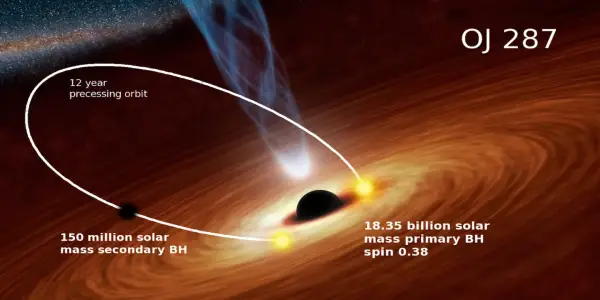
In a groundbreaking achievement, astronomers have successfully imaged a pair of black holes in orbit around each other, marking a significant milestone in our understanding of these cosmic phenomena.
In-depth analysis
New discoveries
The Event Horizon Telescope collaboration has achieved a groundbreaking milestone by capturing the first radio image of two black holes in orbit around each other, located in the quasar OJ287. This discovery confirms the existence of binary black holes, with the primary black hole estimated at 18 billion solar masses, while its companion weighs about 150 million solar masses.
Mission updates
The Event Horizon Telescope continues to expand its capabilities, successfully employing advanced radio imaging techniques to observe the unique emissions from the accretion disks of these black holes, a feat not accomplished before.
Who is affected
This discovery impacts the scientific community engaged in astrophysics and cosmology, as it enhances understanding of black hole formation and evolution. Additionally, it could influence future research on the dynamics of galaxies and their interactions with supermassive black holes.
Next steps
Researchers plan to further investigate the implications of this discovery, focusing on the role of binary black holes in galaxy evolution and refining models of black hole interactions based on the new observational data.
Did you know?
Why we should care
The discovery of black hole pairs has profound implications for our understanding of the universe. It challenges our perceptions of galactic evolution and the forces that govern it. This knowledge can also inspire future generations of scientists and curious minds, sparking interest in astrophysics and the mysteries of space. Ultimately, it connects us to the cosmos, reminding us of our place in an ever-expanding universe.
The universe's unsolved mystery
While the confirmation of binary black holes in quasars is significant, it raises further questions about their formation and evolution. How did these massive entities come to coexist in such close proximity? Are they common throughout the universe? These mysteries continue to intrigue astronomers, as understanding their origins could unlock secrets about the very fabric of spacetime.
The person who looks at the stars
For 12-year-old Mia, stargazing has always been a source of wonder. Living in a small town, she often drags her telescope to the backyard, dreaming of the unknown. When she heard about the discovery of binary black holes, her eyes lit up with excitement. To her, they represent not just distant giants, but the possibility of countless worlds and mysteries waiting to be explored. Inspired by scientists working on the Event Horizon Telescope, Mia sees herself one day contributing to the field of astronomy. Each night spent gazing at the stars fills her with hope and curiosity, reaffirming why we look up at the night sky—it's a reminder that the universe is vast and full of surprises.
Ancient Galaxies: A Chaotic Early Universe...
Russian Cosmonauts Conduct Extended Spacewalk to...

Samsung Unveils Unprecedented Black Friday Deal...
Unraveling the Mysteries of Mars: Recent...
Assessing the Financial Impact of NASA's Apollo...

India Successfully Launches CMS-03 Military...
NASA's Campaign to Monitor Interstellar Comet...
Discovery of a Planet Formation Zone Beyond...
Interstellar Comet 3I/ATLAS Approaches...
Webb Telescope Reveals Unprecedented Cosmic...

Mapping the Invisible: Astronomers Uncover Dark...
Exploring the Composition of Cosmic Voids
James Webb Space Telescope May Have Detected the...
James Webb Space Telescope Discovers Ancient...
NASA's Ambitious Timeline for Human Exploration...

Unistellar eQuinox 2 Smart Telescope Sees...
Blue Origin Faces Major Setback as New Glenn...

Urwerk Unveils Limited-Edition 100V 'LightSpeed'...

Daily Roundup: November 10, 2025 – Advancements...

Satellite Imagery Reveals Extensive Damage Across...
Jupiter's Moons Io and Europa to Cast Shadows...

Astronomers Identify Three Earth-Sized Exoplanets...

Apple Introduces Emergency SOS via Satellite in...
Euclid Space Telescope Discovers Hidden Stars in...
NASA's X-59 Achieves Historic Supersonic Flight
Astronauts aboard the ISS Capture Stunning Images...
James Webb Telescope Identifies Rapidly Growing...
Young Canadian Astronomer Identifies Two...

X-Men Return to Education in Upcoming Comic...
Intense Solar Storm May Illuminate Skies Across...
Potential Alien Disclosure May Trigger Bitcoin...

Artemis 2 Astronauts Safely Return After Historic...

This Week In Space Podcast: Episode 187 Explores...

European Space Agency Unveils Stunning Radar...

Charlotte: The Lunar 3D Printer Poised to...

Exploring Alternatives to the Meta Quest 3 Elite...
SpaceX Set to Launch NASA's Pandora Exoplanet...
Hubble Telescope Unveils Enigmatic Galaxy NGC 2775