Perseverance Rover Discovers Unusual Rock Near Jezero Crater
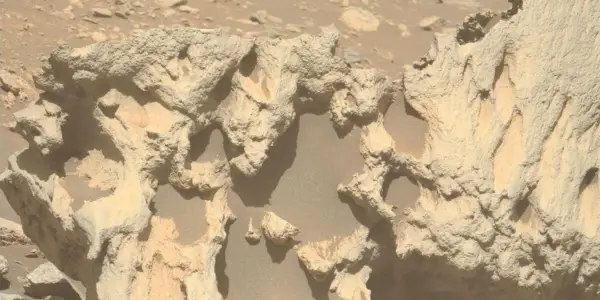
NASA's Perseverance rover uncovers a unique rock formation near Jezero Crater, potentially an iron-nickel meteorite, shedding light on Mars' ancient impacts.
In-depth analysis
Natural phenomena
The Perseverance rover has uncovered a remarkable rock formation, dubbed 'Phippsaksla', at the Vernodden site in Jezero Crater. This unique structure, characterized by its sculpted contours, stands out among the surrounding debris. Preliminary findings indicate that it could be an iron-nickel meteorite, a type more frequently found in meteorite collections than on Earth.
Impact on communities
This discovery holds significant implications for planetary science communities, enhancing understanding of Mars' geological history and the nature of its meteorite impacts. It fosters collaborative research efforts among scientists worldwide.
Scientific updates
The analysis of Phippsaksla is ongoing, with scientists employing advanced tools like SuperCam to assess its mineral composition. This investigation aims to confirm whether it is indeed an iron-nickel meteorite, contributing valuable data to the study of Martian geology.
Future outlook
As Perseverance continues its exploration, the potential inclusion of Phippsaksla in its sample collection for Earth return missions could offer unprecedented insights into the planet's past. Ongoing monitoring will determine its significance in understanding Mars' meteorite history.
Did you know?
Why this matters for our planet
The discovery of Phippsaksla could reshape our understanding of planetary formation and the history of our solar system. By studying meteorites like this one, scientists gain insights into the building blocks of Earth and other planets. This knowledge can inform how we explore space, impacting future missions and possibly revealing resources that could sustain human life beyond our planet.
Earth's undiscovered wonder
Around 90% of meteorites that hit Earth are stony, with only about 5% being iron-nickel types like Phippsaksla. These rare meteorites originate from the cores of ancient asteroids, providing clues about the early solar system's formation and the violent collisions that shaped our celestial neighborhood.
The voice of Earth
Marcus, 34, from Chicago, always gazed at the night sky, wondering about the mysteries it held. When he learned about the Perseverance rover's discovery of Phippsaksla, he felt a deep connection to the cosmos. As a child, his grandfather, an amateur astronomer, would often take him stargazing, sharing stories of meteor showers and the wonders of space. This new discovery reignited those cherished memories, prompting Marcus to join a local astronomy club. Now, he shares his passion with others, encouraging them to appreciate the universe and our shared connection to it, highlighting how even the smallest discoveries can inspire a sense of wonder and unity.

Reassessing Economic Growth: Valuing Natural...
James Webb Space Telescope Reveals First 3D...
NASA's Mars Sample Return Mission Faces...
Jupiter's Rapid Spin Influences Water...

The Impact of the Three Gorges Dam on Earth's...
Ancient Lakes on Mars: New Research Unveils Ice...
New Study Reveals Microbes Colonizing Freshly...
New Fossil Discovery Alters Understanding of...

Intaaya Retreat in Indonesia Features Innovative...
New Research Suggests Water Could Form During...

Exploring Key Questions Raised by ‘Avatar: Fire...
Understanding Artificial Reefs: A Solution for...
The Challenges of Sending a Supervillain into the...

Top Organic Mattresses of 2025: Birch, Avocado,...
Geomagnetic Storm Forces Delay of Blue Origin's...
Upcoming Venus Missions Set to Explore Earth's...

The Allure of Venezuela's Oil Reserves: Analyzing...

US Government to Halt SNAP Benefits Amid Ongoing...

VTN Architects Completes Nuoc Ui School in...


November's Full Supermoon: A Celestial Event to...

The Earth’s Value: An Exploration of Its...
HEO Robotics Expands Satellite Imaging...
Artemis II Sparks Renewed Interest in Lunar...

Natural History Museums: Essential Partners in...
Perseverance Rover Discovers Unusual Rock Near...

Exploring the Depths of Nature: Boyd Varty's...
Exploring Sustainable Approaches to Deep-Sea...
Breakthrough in Microscopy Sheds Light on Ocean's...

Notable Aquatic Highlights from the 2025 Nature's...

Innovative Gel Shows Promise in Regenerating...

Steven Spielberg Steps Back from Sci-Fi Series...

Exploring the Nature of Intelligence: Insights...

SpaceX to Launch Over 100 Satellites Today on...
New Research Sheds Light on Jet Streams of Gas...

Johnny Keefer's Ascent Raises Questions About...
Asteroid Impact in Finland Reveals Ancient...
Ancient Australian Rocks Provide Insights into...
Supercomputers Analyze Enceladus's Plume Dynamics