NASA's MAVEN Mars Orbiter Loses Signal Amid Ongoing Investigations
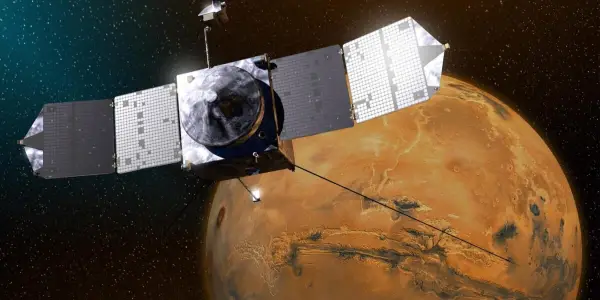
NASA's MAVEN Mars orbiter has lost communication during its mission, prompting investigations. Discover the implications for Martian exploration and future u...
In-depth analysis
Natural phenomena
NASA's MAVEN orbiter, crucial for studying Mars' atmosphere, has encountered a communication anomaly after losing contact while transitioning behind the planet. This incident exemplifies the challenges faced by spacecraft operating in extraterrestrial environments, where communication disruptions can significantly impact ongoing scientific missions and data collection.
Impact on communities
The loss of contact with MAVEN poses potential setbacks for scientific communities reliant on its data, affecting research on Mars' atmosphere and climate history, which are vital for understanding planetary habitability.
Scientific updates
MAVEN, operational since 2014, has provided essential insights into Mars' atmospheric changes and has recently captured images of interstellar object 3I/ATLAS. However, ongoing communication issues may hinder its ability to relay critical data back to Earth.
Future outlook
With proposed budget cuts threatening MAVEN's mission, the orbiter's future remains uncertain. The recent allocation of funds for a new Mars telecommunications orbiter may provide some hope, but the overall sustainability of NASA's long-term exploration efforts is in question.
Did you know?
Why this matters for our planet
Understanding Mars' atmosphere and climate history is crucial for grasping how planetary environments evolve. This knowledge directly affects Earth, as it sheds light on climate change and atmospheric loss. Insights gained from MAVEN may inform our approaches to preserving Earth’s own atmosphere and safeguarding our planet's habitability for future generations.
Earth's undiscovered wonder
Mars has a unique, thin atmosphere composed of over 95% carbon dioxide, making it inhospitable for human life. However, MAVEN's research indicates that ancient Mars may have had conditions suitable for life, with flowing water and a thicker atmosphere, raising questions about what planetary transformations can tell us about our own climate challenges.
The voice of Earth
Marcus, 34, from Chicago, grew up watching space documentaries with his father, who dreamed of one day traveling to Mars. Now, as a software engineer, Marcus feels a deep connection to the MAVEN orbiter's mission. He often reflects on the importance of its data, not just for understanding Mars but for drawing parallels to Earth's climate issues. The potential loss of MAVEN feels personal to him; it symbolizes the fragile bridge between human curiosity and the future of planetary exploration. Each time he hears news of MAVEN's challenges, it reminds him of his father's dreams and the urgency to protect our planet while seeking answers beyond it.

Ancient Crocodile Fossils Unearthed in Australia...
Damage Assessment Underway in Northern Australia...
Innovative Engine Harnesses Deep Space Energy for...
Blue Origin's New Glenn Rocket Successfully Lands...

WhatsApp Security Vulnerability Exposes 3.5...
Study Reveals Fast Healing of Deep Earthquake...
Insights into Lithospheric Dynamics from Turkana...
The Challenges of Sending a Supervillain into the...
The Earth’s Value: An Exploration of Its...

Post-Artemis 2: What Insights Will Scientists...

Natural History Museums: Essential Partners in...
Time on Mars Outpaces Earth, Unveiling Challenges...
Reassessing Economic Growth: Valuing Natural...
Upcoming Venus Missions Set to Explore Earth's...

VTN Architects Completes Nuoc Ui School in...

Newly Discovered Snake Species Named After Steve...

Google Enhances Weather Forecasting with...
China's Astronauts Return Safely, but Another...
New Research Sheds Light on Jet Streams of Gas...

The Intersection of AI Development and Natural...
Significant Geomagnetic Storm Unleashes Auroras...

Putin Initiates Strategic Plan for Russia's Rare...
Understanding Artificial Reefs: A Solution for...

Exploring the Depths of Nature: Boyd Varty's...

Innovative Gel Shows Promise in Regenerating...

Google Launches WeatherNext 2: Enhanced AI...
Ancient Air Trapped in 6-Million-Year-Old...

The Impact of the Three Gorges Dam on Earth's...

Interstellar Comet 3I/ATLAS Reaches Perihelion,...
Significant Solar Activity Forecasted to Cause...

Top Organic Mattresses of 2025: Birch, Avocado,...
Intense Solar Activity: Sunspot Region Produces...

Intaaya Retreat in Indonesia Features Innovative...
New Ice Age Episodes of Prehistoric Planet Now...
Innovative Use of Underwater Speakers Aims to...

Innovative Precast Rammed Earth Tennis Court...
New Research Suggests Water Could Form During...
Understanding the Formation of Tectonic Plates
Embracing the Light: A Reflection on Our...