First-Ever Live Footage Captured of Rare Goblin Shark in Natural Habitat
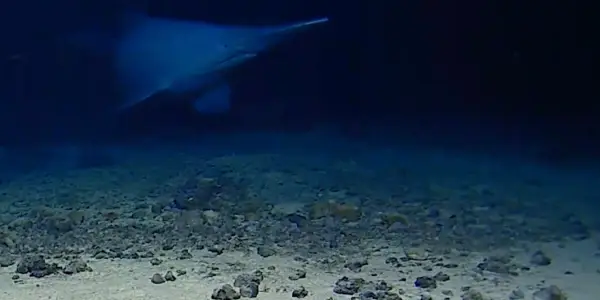
Marine biologists have recorded the elusive goblin shark alive for the first time, revealing insights into its habitat deep in the Tonga Trench.
In-depth analysis
Natural phenomena
The goblin shark, a remarkable species often dubbed a 'living fossil,' has been filmed alive for the first time in its natural habitat within the Tonga Trench. This deep-sea environment, characterized by extreme conditions, has revealed the shark at depths exceeding 6,500 feet, showcasing its unique adaptations and highlighting the mysteries of marine life in such uncharted territories.
Impact on communities
The discovery of the goblin shark in its natural habitat has significant implications for coastal communities. As awareness grows about deep-sea species, local fishermen and policymakers may need to adapt their practices to ensure the protection of vulnerable marine life.
Scientific updates
Recent findings have expanded the known geographic and depth range of the goblin shark, previously recorded only in limited regions. The study published in the Journal of Fish Biology reveals a remarkable increase in the depth range of lamniform sharks, providing new insights into their biology and ecology.
Future outlook
The implications of this research are far-reaching, urging a reevaluation of conservation strategies for deep-sea species. As exploration continues, there is hope that further discoveries will enhance our understanding of marine ecosystems and promote sustainable practices.
Did you know?
Why this matters for our planet
The discovery of the goblin shark in its natural habitat highlights the fragility of marine ecosystems. With increasing pressures from overfishing and pollution, the presence of this 'living fossil' underscores the need for better conservation strategies. Protecting such unique species not only preserves biodiversity but also ensures healthier oceans, which directly impacts our food sources and climate stability.
Earth's undiscovered wonder
The goblin shark, often dubbed a 'living fossil,' has existed for over 125 million years and features a unique jaw structure that allows it to extend its mouth to catch prey rapidly. This adaptation is one of the reasons it has survived various mass extinctions, making its recent sighting a remarkable event in marine biology.
The voice of Earth
Marcus, 34, from Chicago, has always felt a deep connection to the ocean, spending summers by the Great Lakes. When he heard about the live footage of the goblin shark, he was captivated. 'It's like finding a piece of history,' he said, recalling his childhood fascination with sea creatures. For Marcus, this discovery is a reminder of the ocean's mysteries and the urgent need to protect its inhabitants. He now advocates for sustainable fishing practices, inspired by the idea that every creature, even one as rare as the goblin shark, plays a crucial role in our ecosystem.
Expert Commentary
Young Star V1298 Tau Sheds Light on Planet...

Geomagnetic Storm Forces Delay of Blue Origin's...
Natural History Museums: Essential Partners in...

Johnny Keefer's Ascent Raises Questions About...

Exploring Key Questions Raised by ‘Avatar: Fire...

Catherine O’Hara, Iconic Actress from...

New Research Suggests Water Could Form During...

Sun Unleashes Spectacular Solar Flare Amid...

American Museum of Natural History Launches...

Rammed Earth Homes of 2026 Showcase Sustainable...
Perseverance Rover Discovers Unusual Rock Near...
The Late Ordovician Mass Extinction: A Pivotal...

Significant Geomagnetic Storm Unleashes Auroras...

The Earth’s Value: An Exploration of Its...
New Research Sheds Light on Jet Streams of Gas...
Supercomputers Analyze Enceladus's Plume Dynamics

New Insights from the Butterfly Nebula May...

HEO Robotics Expands Satellite Imaging...

SpaceX to Launch Over 100 Satellites Today on...

The Allure of Venezuela's Oil Reserves: Analyzing...

Sun Emits Second-Strongest Flare of 2025, Causing...
Asteroid Impact in Finland Reveals Ancient...

Upcoming Venus Missions Set to Explore Earth's...
New Fossil Discovery Alters Understanding of...
Breakthrough in Microscopy Sheds Light on Ocean's...

Exploring the Nature of Intelligence: Insights...

New Study Reveals Microbes Colonizing Freshly...

New Ice Age Episodes of Prehistoric Planet Now...

Rising Frustration in Aceh as Flood Relief...

VTN Architects Completes Nuoc Ui School in...

Intaaya Retreat in Indonesia Features Innovative...
Innovative Architectural Designs Inspired by...

Damage Assessment Underway in Northern Australia...

Artemis II Sparks Renewed Interest in Lunar...

Exploring Sustainable Methods for Rare Earth...

Reassessing Economic Growth: Valuing Natural...

Google Launches WeatherNext 2: Enhanced AI...

The Challenges of Sending a Supervillain into the...