NASA's Psyche Mission Set for Critical Mars Flyby
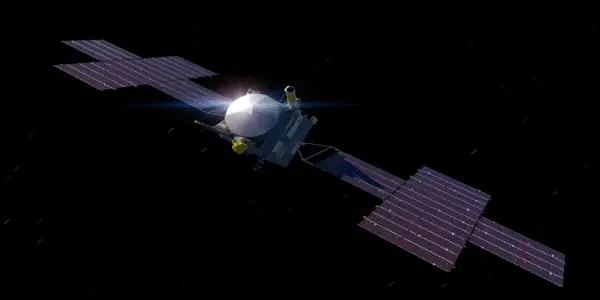
NASA's Psyche spacecraft is scheduled for a vital gravity assist maneuver near Mars to enhance its trajectory toward a metal-rich asteroid.
In-depth analysis
Natural phenomena
The upcoming flyby of Mars by NASA's Psyche mission exemplifies the intricate dance of celestial mechanics. Utilizing gravity assists, the spacecraft will approach within 2,000 kilometers of the Martian surface, allowing it to harness the planet's gravitational pull to adjust its trajectory toward a metal-rich asteroid. This maneuver highlights the dynamic interactions between spacecraft and planetary bodies.
Impact on communities
The Psyche mission's advancements in space exploration foster a sense of collective pride and curiosity among communities. As the mission progresses, public interest in space science and technology is likely to grow, inspiring future generations.
Scientific updates
Recent preparations for the Mars flyby include extensive thruster engagement, refining Psyche's approach for optimal trajectory adjustment. The mission will utilize Doppler shift measurements to confirm speed changes, while also testing a multispectral imager designed to capture detailed Martian observations, enhancing the mission's scientific objectives.
Future outlook
With an expected arrival at its asteroid target in 2029, the Psyche mission represents a significant step in deep space exploration. The successful Mars flyby will not only facilitate trajectory adjustments but also enhance the scientific capabilities of the mission, paving the way for further discoveries.
Did you know?
Why this matters for our planet
The Psyche mission highlights our quest to understand the building blocks of planetary formation. By studying a metal-rich asteroid, scientists aim to unlock secrets about Earth's own history. Such insights could inform how we manage our planet's resources, improve technology for sustainable mining, and enhance our understanding of celestial bodies that may one day impact Earth.
Earth's undiscovered wonder
Mars, the fourth planet from the sun, has the tallest volcano in the solar system, Olympus Mons, which stands about 13.6 miles high—almost three times the height of Mount Everest. This astonishing feature showcases the planet's geological activity and provides clues about the processes that shaped not just Mars, but potentially other rocky planets, including Earth.
The voice of Earth
Marcus, 34, from Chicago, remembers gazing at the night sky as a child with his grandfather, who would tell stories of the stars and planets. Now, as an aerospace engineer, he feels a deep connection to missions like Psyche, understanding that every flyby and maneuver is a step towards uncovering the universe's mysteries. Recently, he participated in a community event where students learned about gravitational assists. Seeing their excitement reignited his childhood wonder, reminding him that these missions are not just scientific endeavors; they inspire the next generation to dream big and explore the unknown.
Expert Commentary
Mars Express Reveals Evidence of Ancient Ice Age...
Perseverance Rover Discovers Unusual Rock Near...

Microsoft Integrates NASA's Satellite Data into...


Reassessing Economic Growth: Valuing Natural...

Ancient Air Trapped in 6-Million-Year-Old...
Embracing the Light: A Reflection on Our...
Blue Origin's New Glenn Rocket Set to Launch...

Supercomputers Analyze Enceladus's Plume Dynamics

Rising Frustration in Aceh as Flood Relief...
Abrams Studios Announces New Sci-Fi Exploration...

Comet Lemmon Illuminates the Skies Over England

Ancient Australian Rocks Provide Insights into...
Explosive Discoveries: CO₂ Ice Blocks May Be the...

UK Churches Embrace Heat Pumps for Sustainable...

Exocomets Detected Around Distant Stars

Exploring the Conclusion of 'Predator: Badlands'
Sun Emits Second-Strongest Flare of 2025, Causing...

New Insights from the Butterfly Nebula May...
Study Reveals Fast Healing of Deep Earthquake...
October 2025 New Moon Offers Rare Antares...

Tennessee's Nature-Based Solutions for Health and...
Interstellar Comet 3I/ATLAS Reaches Perihelion,...
Blue Origin's New Glenn Rocket Successfully Lands...

Ancient Crocodile Fossils Unearthed in Australia...

Portable Libraries: A Lifeline When Internet...

Indigenous Activists Challenge COP30's Rainforest...

Exploring Sustainable Methods for Rare Earth...

Reassessing the Impact of Farmed Seafood on Ocean...

WhatsApp Security Vulnerability Exposes 3.5...

The Late Ordovician Mass Extinction: A Pivotal...
Upcoming Venus Missions Set to Explore Earth's...
Sun Unleashes Spectacular Solar Flare Amid...

November's Full Supermoon: A Celestial Event to...

Aging Stars Pose Threat to Nearby Planets, New...

Innovative Use of Underwater Speakers Aims to...

VTN Architects Completes Nuoc Ui School in...
China's Astronauts Return Safely, but Another...

Exploring Sustainable Approaches to Deep-Sea...

Newly Discovered Snake Species Named After Steve...