October 2025 New Moon Offers Rare Antares Occultation for Stargazers in South America
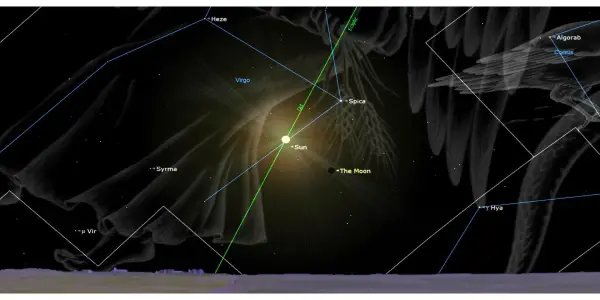
As the new moon ushers in dark skies, South American observers will have the opportunity to witness the red supergiant star Antares being obscured for three days, coinciding with the peak of the Orionid meteor shower.
In-depth analysis
Natural phenomena
The new moon on October 8, 2025, will create a rare astronomical spectacle as it passes in front of the red supergiant star Antares, resulting in an occultation. This event, observable over three days, coincides with the peak of the Orionid meteor shower, enhancing the celestial experience for stargazers in South America.
Impact on communities
Cities like Ushuaia, Argentina, and Punta Arenas, Chile, stand to benefit significantly from this celestial event, drawing local and international observers eager to witness the occultation of Antares.
Scientific updates
Astronomy experts emphasize the significance of dark skies for optimal viewing conditions, noting that urban light pollution can hinder the visibility of such rare events. This forthcoming occultation serves as a reminder of the delicate balance between urban development and astronomical observation.
Future outlook
As interest in astronomy continues to rise, opportunities like the Antares occultation are likely to inspire greater public engagement and appreciation for celestial events, fostering a new generation of astronomy enthusiasts.
Did you know?
Why this matters for our planet
The upcoming occultation of Antares by the moon underscores the importance of preserving dark skies for both environmental health and human connection to the cosmos. Urban light pollution not only obscures celestial wonders but also disrupts ecosystems, affecting nocturnal wildlife. By advocating for darker skies, communities can enhance stargazing experiences while fostering a greater appreciation for the universe's beauty and biodiversity.
Earth's undiscovered wonder
Did you know that Antares, the star that will be obscured by the moon during the occultation, is nearly 600 light-years away from Earth? This supergiant star is about 700 times the diameter of our sun, making it one of the largest known stars in our galaxy. Its vibrant red hue is a reflection of its cooler surface temperature compared to other stars.
The voice of Earth
Marcus, 34, from Chicago, has always felt a deep sense of wonder when looking up at the night sky. As a child, he would sit on his roof with his grandfather, who taught him the stories behind the stars. Now, he plans to travel to Ushuaia for the Antares occultation. The thought of witnessing this rare event fills him with nostalgia and excitement, reminding him of the bond he shared with his grandfather. To Marcus, stargazing is not just a hobby; it’s a connection to his past and a chance to marvel at the universe’s mysteries.

Turkey Declines Rare Earth Element Sales to the...

Ancient Crocodile Fossils Unearthed in Australia...

New Technique Unveils Natural Clock in Dinosaur...

Innovative Architectural Designs Inspired by...

WhatsApp Security Vulnerability Exposes 3.5...

Innovative Precast Rammed Earth Tennis Court...

The Intersection of AI Development and Natural...
Supercomputers Analyze Enceladus's Plume Dynamics

Innovative Technique Utilizes Dragonberry Weed to...

Asteroid Impact in Finland Reveals Ancient...


Artemis II Sparks Renewed Interest in Lunar...

New Glenn Rocket Completes Successful Test...

SpaceX to Launch Over 100 Satellites Today on...

Ancient Lakes on Mars: New Research Unveils Ice...
Abrams Studios Announces New Sci-Fi Exploration...

Exploring Sustainable Methods for Rare Earth...

Intense Solar Activity: Sunspot Region Produces...

Pacific Northwest's Subduction Zone Revealed to...

Study Reveals Fast Healing of Deep Earthquake...

Understanding the Formation of Tectonic Plates
Jupiter's Rapid Spin Influences Water...
New Research Suggests Water Could Form During...

US Greenhouse Gas Emissions Increase Amid Cold...
Exocomets Detected Around Distant Stars

UK Churches Embrace Heat Pumps for Sustainable...

Catherine O’Hara, Iconic Actress from...

Rammed Earth Homes of 2026 Showcase Sustainable...
New Insights from the Butterfly Nebula May...

Coyote vs. Acme Blends Looney Tunes with...

Apple Offers Support Following Fire in Hong Kong

Tennessee's Nature-Based Solutions for Health and...

Innovative Gel Shows Promise in Regenerating...
Sun Unleashes Spectacular Solar Flare Amid...

Exploring the Conclusion of 'Predator: Badlands'

American Museum of Natural History Launches...

Geomagnetic Storm Forces Delay of Blue Origin's...

Understanding Artificial Reefs: A Solution for...

Intaaya Retreat in Indonesia Features Innovative...