Jupiter's Particle Acceleration Reveals Cosmic Insights
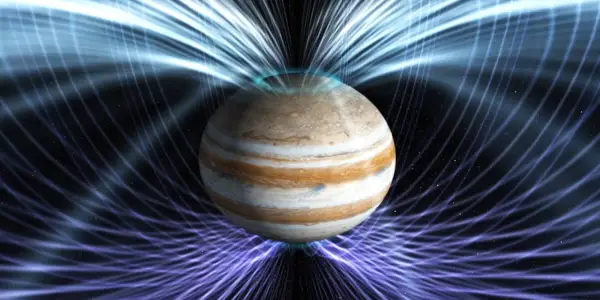
New research shows Jupiter's bow shock accelerates particles to near-light speeds, providing insights into cosmic phenomena and energy sources.
In-depth analysis
Natural phenomena
Jupiter's bow shock, formed by its magnetosphere interacting with solar wind, serves as a unique natural laboratory for studying extreme particle physics. Recent findings reveal that electrons can attain near-light speeds within this turbulent region, showcasing the complex dynamics of cosmic environments that terrestrial particle accelerators cannot replicate.
Impact on communities
The insights gained from Jupiter's extreme particle physics may influence various scientific fields, enhancing our understanding of cosmic events that affect Earth, such as cosmic rays and their potential impact on technology and health.
Scientific updates
Led by Savvas Raptis, recent research indicates that Jupiter's foreshock acts as a powerful particle accelerator, surpassing Earth-based systems. Juno's instruments, JEDI and JADE, have provided essential data, offering new perspectives on cosmic particle acceleration mechanisms.
Future outlook
The ongoing research into Jupiter's magnetosphere promises to deepen our understanding of high-energy particle physics. Insights gained may not only clarify cosmic ray behavior but also influence theories related to supernova remnants and young stellar formations.
Did you know?
Why this matters for our planet
Understanding Jupiter's extreme particle accelerators provides valuable insights into cosmic ray behavior, which directly impacts Earth’s atmosphere and climate. These high-energy particles influence weather patterns and can even affect satellite operations. By studying such phenomena, scientists can better predict solar events that could disrupt technology on Earth, highlighting the interconnectedness of our solar system.
Earth's undiscovered wonder
Jupiter's magnetosphere is so powerful that it extends nearly 4 million kilometers into space, forming a protective bubble around the planet. This immense shield not only captures cosmic rays but also creates a unique environment where particles can reach speeds close to light. Such extreme conditions cannot be replicated on Earth, making Jupiter a natural laboratory for particle physics.
The voice of Earth
Marcus, 34, from Chicago, often gazes at the night sky, marveling at the stars. As a child, he was captivated by stories of cosmic wonders, but it wasn't until he learned about Jupiter's particle accelerators that he felt a deeper connection. The idea that the cosmos is constantly at work, influencing life on Earth, ignited his passion for science. Now, as a physics teacher, he shares this fascination with his students, inspiring a new generation to explore the universe's mysteries. For Marcus, understanding Jupiter is not just academic; it’s a bridge to the stars, linking his students to the grandeur of the cosmos.
Expert Commentary

VTN Architects Completes Nuoc Ui School in...

The Impact of the Three Gorges Dam on Earth's...
China's Astronauts Return Safely, but Another...
Innovative Gel Shows Promise in Regenerating...

Rising Frustration in Aceh as Flood Relief...
Insights into Lithospheric Dynamics from Turkana...
Time on Mars Outpaces Earth, Unveiling Challenges...

US Government to Halt SNAP Benefits Amid Ongoing...
Understanding Artificial Reefs: A Solution for...
Jupiter's Rapid Spin Influences Water...
Significant Solar Activity Forecasted to Cause...
American Museum of Natural History Launches...
The Allure of Venezuela's Oil Reserves: Analyzing...

Exploring the Depths of Nature: Boyd Varty's...


Apple Offers Support Following Fire in Hong Kong

Indigenous Activists Challenge COP30's Rainforest...

Reassessing Economic Growth: Valuing Natural...
Geomagnetic Storm Forces Delay of Blue Origin's...

Exploring the Conclusion of 'Predator: Badlands'

Damage Assessment Underway in Northern Australia...
Exploring Sustainable Approaches to Deep-Sea...

Exploring the Nature of Intelligence: Insights...
Artemis II Sparks Renewed Interest in Lunar...

New Technique Unveils Natural Clock in Dinosaur...
New Study Reveals Microbes Colonizing Freshly...
Innovative Engine Harnesses Deep Space Energy for...

Newly Discovered Snake Species Named After Steve...

Steven Spielberg Steps Back from Sci-Fi Series...

WhatsApp Security Vulnerability Exposes 3.5...

Putin Initiates Strategic Plan for Russia's Rare...

New Ice Age Episodes of Prehistoric Planet Now...

Pacific Northwest's Subduction Zone Revealed to...
Study Reveals Fast Healing of Deep Earthquake...

Reassessing the Impact of Farmed Seafood on Ocean...
Young Star V1298 Tau Sheds Light on Planet...
First Mosquito Sightings in Iceland Linked to...

Post-Artemis 2: What Insights Will Scientists...
Exocomets Detected Around Distant Stars