Astronomers Discover Rogue Planet Consuming Six Billion Tons of Material Per Second
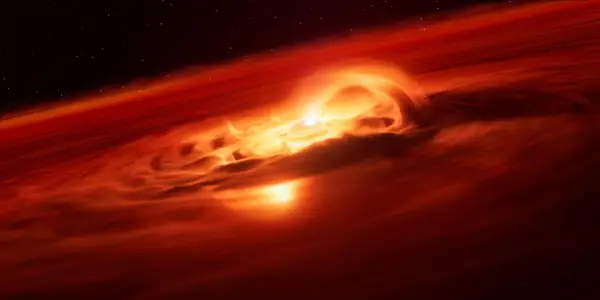
A newly observed rogue planet, Cha 1107-7626, located 620 light-years away in the Chamaeleon constellation, is exhibiting unprecedented growth by devouring six billion tons of gas and dust every second.
In-depth analysis
New discoveries
Astronomers have made a significant breakthrough by identifying Cha 1107-7626, a rogue planet consuming six billion tons of gas and dust every second. This celestial body, located 620 light-years away, challenges traditional views of planetary stability and showcases unprecedented growth behavior, marking a pivotal moment in the study of rogue planets.
Mission updates
The research team, led by Víctor Almendros-Abad, has recorded the fastest known accretion rate for a planetary-mass object, indicating a dramatic increase in the planet's growth. This finding highlights the dynamic nature of Cha 1107-7626.
Who is affected
The implications of this discovery extend to astronomers and astrophysicists, who are reevaluating the formation and evolution of rogue planets. Understanding these celestial bodies may also influence theories about planetary formation in general, impacting broader astronomical research.
Next steps
The upcoming Extremely Large Telescope promises to enhance the study of rogue planets significantly. Its advanced capabilities will allow astronomers to detect more of these elusive objects, paving the way for deeper insights into their formation and characteristics.
Did you know?
Why we should care
The discovery of Cha 1107-7626 reshapes our understanding of planetary formation and dynamics, impacting not just astronomy but also our comprehension of the universe's evolution. This newfound knowledge could influence the search for exoplanets and extraterrestrial life, potentially impacting future technologies and scientific endeavors that rely on our understanding of how celestial bodies, including those outside our solar system, come into existence.
The universe's unsolved mystery
Rogue planets like Cha 1107-7626 challenge our understanding of celestial bodies. As they drift through space without a star, their origins remain elusive. Are they remnants of destroyed solar systems or born independently? Unraveling this mystery could reveal insights into the fundamental processes of planetary and stellar formation, offering a clearer picture of our cosmic neighborhood.
The person who looks at the stars
Meet Elena, a high school astronomy teacher in a small town. Every night, she takes her students to the local observatory, where they gaze at the stars, dreaming of distant worlds. The news of Cha 1107-7626 excites her, sparking conversations about the vastness of the universe and the unknown. For Elena, this discovery isn’t just scientific; it’s a way to inspire her students to think beyond the classroom and envision themselves as future astronomers or scientists. She believes that understanding rogue planets can ignite curiosity and passion for exploration in the next generation. In teaching them about Cha 1107-7626, she’s not just sharing facts; she’s fostering a sense of wonder about their place in the universe.
Expert Commentary
Italian Producer Plans Historic Film to Shoot in...

General Relativity May Extend Habitability of...

Unistellar eQuinox 2 Smart Telescope Sees...
Young Canadian Astronomer Identifies Two...

OnePlus 15 vs. Samsung Galaxy S25 Plus: A Clash...
Interstellar Comet 3I/ATLAS Reveals Water...

Czech Startup Zaitra Pioneers AI-Driven Satellite...
Meteorite Fragment May Have Impacted Houston Home
Research Reveals Mars' Windy Conditions Could...
Portal Systems Aims to Revolutionize Spacecraft...

Japanese Astronaut Observes Typhoon Activity from...

MiHoYo Expands Ambitions with New MMO Project...

Exploring Alternatives to the Meta Quest 3 Elite...
Nearby Super-Earth Identified as Key Target in...

China's Shenzhou 22 Mission Launches Uncrewed...

Urwerk Unveils Limited-Edition 100V 'LightSpeed'...

Unusual Wind from Neutron Star Challenges Space...

Lenovo's Legion Tab Gen 3 Sees Significant Black...
Potential Evidence of Dark Matter Emerges from...
The Dwarf III Smart Telescope: A Compact Marvel...

Hackaday Podcast Episode 340: Exploring Top...
Assessing the Financial Impact of NASA's Apollo...
Astronomers Capture Evidence of Dark Matter's...
Artemis 2 Astronauts Safely Return After Historic...
Russian Cosmonauts Conduct Extended Spacewalk to...
Astronomers Discover Eerie 'Cosmic Bat' Nebula in...

This Week In Space Podcast: Episode 187 Explores...

India Successfully Launches CMS-03 Military...

Childcare Crisis: Families Struggle as...

Netgear Orbi 370 Review: An Accessible Wi-Fi 7...
The Pleiades Star Cluster Reveals Its Extensive...
NASA's Ambitious Timeline for Human Exploration...

New Study Reveals Theia and Earth May Have Shared...

Samsung Unintentionally Reveals Galaxy S26 Series...
Highlights of 2025 in Space Exploration: From...
European Space Agency Enhances Collaboration with...

Samsung Unveils Unprecedented Black Friday Deal...
Astronomers Discover Ancient White Dwarf Actively...

NASA Faces Scrutiny Over Boeing Starliner...
Breakthrough in Milky Way Simulation Using AI...