Vibrio pectenicida Identified as the Cause of Sea Star Wasting Disease Impacting Billions
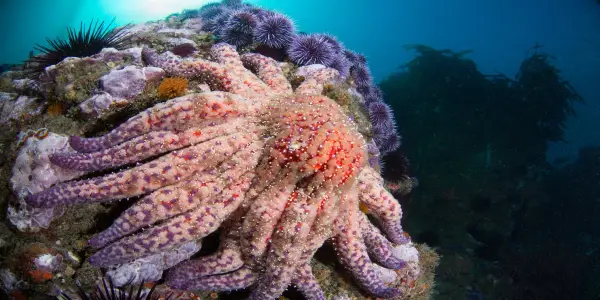
A study identifies Vibrio pectenicida as the cause of sea star wasting disease, killing billions and threatening marine ecosystems, particularly sunflower se...
In-depth analysis
Current environmental changes
The emergence of Vibrio pectenicida has intensified environmental shifts in marine ecosystems, particularly along the Pacific Coast. The phenomenon of sea star wasting disease, exacerbated by rising water temperatures, has led to significant population declines, notably among sunflower sea stars. This disruption threatens the ecological balance, as these predators are vital in regulating sea urchin populations.
Impact on society
The decline of sea star populations affects local fisheries and coastal communities that rely on healthy marine ecosystems. As kelp forests diminish due to unchecked sea urchin growth, the economic repercussions could extend to tourism and biodiversity conservation efforts.
Policy implications
This crisis necessitates urgent policy responses aimed at marine conservation and climate action. Strategies may include habitat protection, breeding programs for disease-resistant sea stars, and enhanced monitoring of marine health to mitigate the impacts of climate change on vulnerable species.
Future outlook
The ongoing research into Vibrio pectenicida provides a critical foundation for future conservation efforts. Continued study and intervention could foster resilience in marine ecosystems, but success will depend on addressing the broader environmental challenges posed by climate change.
Did you know?
Why this concerns all of us
The decline of sea stars, particularly the sunflower star, directly impacts marine ecosystems that many rely on for food and recreation. Healthy kelp forests, which depend on these predators, are crucial for carbon absorption and biodiversity. With the surge in sea urchin populations due to sea star mortality, we face potential collapse of these underwater forests, threatening fisheries and coastal communities that depend on them.
Nature's hidden secret
Interestingly, sea stars have the ability to regenerate lost arms, a remarkable trait that helps them survive predation. However, the devastating effects of Vibrio pectenicida disease have overwhelmed this natural defense, leading to massive mortality rates that disrupt their populations and the ecosystems they support.
The person whose life climate changed
Meet Jenna Torres, a marine biologist who has dedicated her career to studying the delicate balance of coastal ecosystems. Living in Monterey, California, Jenna witnessed the sunflower sea star population plummet in her local waters over the past few years. The loss has not only affected her research but also her community, where local fishermen have reported dwindling catches due to unchecked sea urchin populations. Jenna feels a profound sense of urgency to find solutions, knowing that the health of marine life impacts food security and local economies. Her commitment to restoring these ecosystems is fueled by a deep connection to the ocean, which she views as a living entity deserving of protection.
Expert Commentary

New Delhi Suffers Severe Air Pollution Following...

New Report Highlights Risks of Marine Carbon...

Bill Gates's Climate Remarks Spark Controversy...

Key Outcomes from COP30: Innovations in...

Innovative Approach to Sustainable Living: The...

Portalgraph Revolutionizes 3D Visualization with...

Debate Over Genetic Engineering of Wildlife:...

OpenAI Unveils Ambitious Vibe Coding Initiative,...

Revisiting Pan-African Aspirations Through the...

Pacific Nations Set Ambitious Goal for 100%...

Massive Leak Exposes 183 Million Email Passwords:...

AI Unveils Hidden Lion Roar, Revolutionizing...

Meta Enhances Smart Glasses with Garmin and...

Tehran on the Brink: Water Crisis Highlights...

Deforestation-Free Beef: A Sustainable Approach...

Cate Blanchett Joins Festive Guest Editors for...

Augusta Township Residents Mobilize Against...

South Africa's G20 Agenda: Addressing Debt,...

Emerging Superfoods from the Amazon: Beyond Açaí

Preserving Modern Jewelry and Vintage Heirlooms:...

Conspiracy Theories Divert Attention from Genuine...
Brian Greene to Host Inaugural Global Space...

India's Climate Adaptation Fund Faces Budget Cuts...
Startup Aims to Ignite a New Era in U.S. AI...

Rikako Nagashima's Wool Calendars Highlight...

Doom's Programming Error Sparks Renewed Interest...

California's Proposition 50: Voters Set to...

Rising Temperatures Intensify Skin Conditions...
Revival of Wild Turkeys: A Conservation Triumph...

The Shift in Climate Discourse: Navigating the...

Peaky Blinders: A Catalyst for West Midlands...

Sex Workers Launch 'Anti-OnlyFans' Platform to...

Perrier-Jouët and Design Miami Launch Inaugural...

Unprecedented Strength of Hurricane Melissa Marks...
The Overlooked Link Between Climate Change and...

Revolutionizing Camping: Solar-Powered Tent...

Key Insights on the Future of Electricity Demand...

Bill Gates Advocates for Innovation as Key to...

The Hidden Costs of Men's Alcohol Consumption on...

Joe Swash Opens Up About the Challenges of Being...