2025 Nobel Prize in Physics Celebrates Advances in Macroscopic Quantum Mechanics
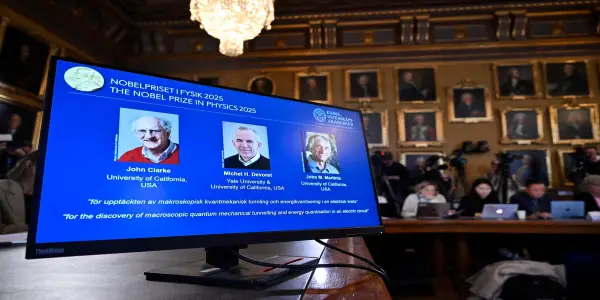
The Royal Swedish Academy of Sciences awards the Nobel Prize in Physics to three researchers for their groundbreaking work in quantum mechanics, highlighting its significance in modern science.
In-depth analysis
Top trending topics
The recent awarding of the 2025 Nobel Prize in Physics to John Clarke, Michel Devoret, and John Martinis has sparked widespread discussions about the implications of their research on ultracold electronics. As the scientific community commemorates the 100th anniversary of quantum mechanics, interest in its applications beyond traditional boundaries is surging, particularly in the realms of quantum computing and electrical engineering.
Audience engagement
Public interest in quantum mechanics is growing, driven by the Nobel Prize announcement and its potential applications. Educational institutions and online platforms are seeing increased inquiries and discussions surrounding quantum phenomena, reflecting a desire for deeper understanding.
Industry impact
The groundbreaking discoveries made by Clarke, Devoret, and Martinis are poised to significantly influence quantum electrical engineering. Their work on circuits that exhibit quantum effects is foundational for developing qubits and enhancing quantum computing technology, paving the way for future innovations in various sectors.
Future trends
As industries increasingly recognize the transformative potential of quantum mechanics, future trends may focus on integrating these principles into practical technologies. This shift could accelerate advancements in quantum computing and other applications, reshaping technological landscapes in the coming years.
Did you know?
Why everyone is talking about this
The award of the 2025 Nobel Prize in Physics to John Clarke, Michel Devoret, and John Martinis isn't just a celebration of their groundbreaking work; it marks a pivotal moment in the evolution of quantum mechanics. Their findings challenge long-held beliefs and hint at a future where quantum principles govern more than just the microscopic realm, potentially transforming industries from computing to materials science.
What stays off-camera
While many recognize quantum mechanics for its theoretical implications, few know that ultracold electronics can enable precision measurements of time at unprecedented levels, leading to advancements in GPS technology and fundamental physics experiments. This real-world application illustrates the profound impact of quantum research on everyday technology.
A day behind the scenes
On the day the Nobel Prize was announced, researchers at the University of California celebrated not just their colleagues’ achievements, but also the collaborative spirit that fueled this groundbreaking work. Lab technician Maria Lopez, who has been with the team for over a decade, shared how the environment encourages open dialogue and creativity. This dynamic led to the serendipitous discovery that a circuit with a quadrillion electrons could exhibit quantum tunneling. Maria reflected on the emotional charge of the moment: 'It felt surreal, like we were witnessing history in the making. We knew we were on the edge of something big, but this recognition is beyond what we imagined.'
Expert Commentary
Exploring Bazzite: A New Contender in the PC...
Exploring the Complexities of Gender Differences...

COP30 in Brazil: Addressing Global Climate Issues...

New York City Mayor-elect Zohran Mamdani Takes...
Unlocking Python Learning with NotebookLM: A...

Incorporating NotebookLM Revolutionizes Freelance...

New Research Offers Effective Method to Safeguard...

Gamers Criticize NBA 2K for Fashion Updates Amid...
The Cognitive Impact of AI: How Tools Like...
Google's NotebookLM Mobile Introduces Enhanced...

Lina Khan Discusses Antitrust Issues on 'The Adam...
BBC Presenter Faces Discipline for On-Air...

The Erosion of Democratic Discourse in America
Google Unveils Gemini 3: A Major Leap in AI...

Germany Reviews Apple's Modifications to App...

Jon Stewart Committed to 'The Daily Show' Amid...

Las Cruces Police Chief Calls for Public Support...

Dispatch Creative Director Critiques Generative...
Integrating ISA Ports into Contemporary...

Netflix Unveils Opening Scene of Stranger Things...
The Enigmatic Ado: A Voice that Defies Visibility
Tim Cook Engages with President Trump and Tech...
Nvidia CEO Warns: Jobs at Risk from AI Users, Not...

UN Highlights Climate-Induced Displacement as...
Asteroid 33 Polyhymnia May Contain Elements...

Shifts in ICE Strategy Following Minneapolis...

The Existential Threat of Artificial General...

Jack Osbourne Faces Backlash for Emotional...

Key Developments in Video Gaming to Anticipate in...

Megyn Kelly Sparks Outrage Over Comments on...

Debunking the Myth: Do Metal Spoons Keep...
Instagram's Adam Mosseri Warns of Authenticity...

Security Risks in Microsoft Teams Highlighted by...

Decline in Popularity of Trump Halloween Costumes...
Understanding AI's Role in Education: Insights...

Norman Reedus Discusses Daryl Dixon's Connection...

Streaming Show Fans Express Discontent Over...
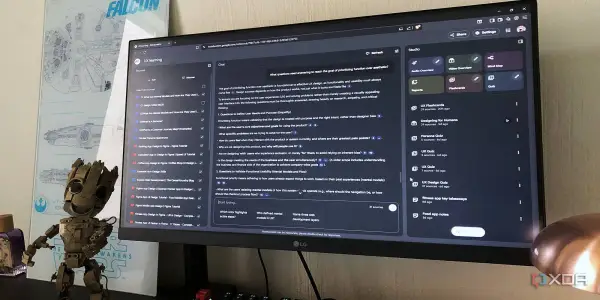
Integrating Obsidian, Zotero, and NotebookLM: A...

Navigating Difficult Family Conversations:...

Trump's Controversial Remarks on Robert Mueller's...