The Iconic BMW M12/13 Turbo Engine: A Triumph in Formula 1 History
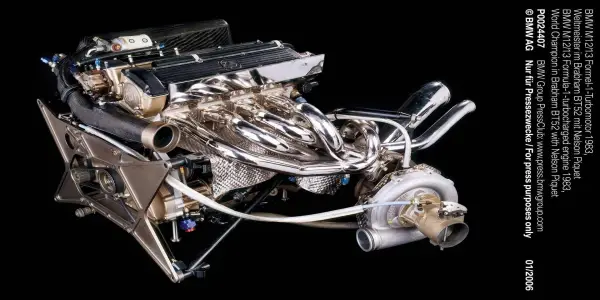
The BMW M12/13 turbocharged four-cylinder engine stands as a monumental achievement in Formula 1, symbolizing the pinnacle of engineering and competitive spirit during the turbo era.
In-depth analysis
Race results
The 1982 Canadian Grand Prix marked a historic moment in Formula 1 as the Brabham BT49, powered by the BMW M12/13 engine, clinched its first victory. Nelson Piquet's triumph not only showcased the engine's potential but also solidified BMW's presence in the sport, setting the stage for future successes throughout the season.
Driver performance
Nelson Piquet's performance in the Brabham BT49 was pivotal, as he navigated the challenges of turbo lag and reliability issues to secure BMW's first Formula 1 win. His skillful driving was instrumental in maximizing the engine's capabilities.
Technical updates
The BMW M12/13 engine underwent significant refinements throughout the 1982 season, including enhancements to turbocharger response and mapping. These updates allowed the engine to reach approximately 800 horsepower in race conditions, showcasing advanced engineering that set new performance benchmarks.
Next race preview
Looking ahead, the next race promises to be a test of endurance and strategy, as teams must manage fuel consumption while harnessing the power of their engines. The evolving dynamics of the turbo era will play a crucial role in determining the outcome.
Did you know?
Why this race will make history
The 1982 Canadian Grand Prix wasn't just another win—it was the moment a radical 1.5-liter four-cylinder engine proved it could beat the established V6 and V8 giants. When Nelson Piquet crossed the finish line, it validated Paul Rosche's daring vision and marked the beginning of a turbocharged legend that would redefine power in Formula 1 forever.
Garage secrets
What the TV cameras never showed was the insane boost pressure. In qualifying trim, the mechanics would crank the M12/13 up to over 5 bar of boost—five times atmospheric pressure—unlocking over 1,000 horsepower from a tiny engine block. The secret was a reinforced cast-iron block with special bearings, built to survive pressures that would blow any other engine apart, even if only for a few laps.
The mechanic's story
Franz, a young mechanic from Munich, still remembers the stress of Sunday mornings in 1983. "We'd arrive at 4 AM to rebuild the engine after Saturday qualifying," he recalls. "The turbo glowed red-hot overnight. We worked in silence, knowing one wrong bolt could cost Piquet the championship. But when that engine screamed to life on the grid, every sleepless night was worth it. We weren't just mechanics; we were keeping a beast alive."

Apple and MLS to Conclude Paid Subscription Model...
Norris Secures Pole Position at Mexican Grand...
Breitling Partners with Aston Martin F1 Team...
Williams Unveils Rebranding for 2026 Formula 1...
Norris Attributes Championship Lead to Enhanced...
Mantis X99 Concept Vehicle Takes Cues from...
McLaren's 2025 Setbacks Forge a Stronger Team,...
Max Verstappen Faces Challenges in Brazilian...
McLaren Faces Scrutiny for Plank Wear Violations...
Lando Norris Faces Booing from Fans at Mexico GP...
Tsunoda Seeks Clarity from Red Bull Following Las...
Liberty Media's CEO Discusses Future...
Marco Bezzecchi Dominates USA MotoGP, Solidifying...
Red Bull to Launch 2026 F1 Season in Detroit,...
FIA Launches Inquiry into Mexico GP Marshal...
Colapinto Critiques Stroll Following Brazil GP...
Starting Grid Unveiled for 2025 F1 Qatar Grand...
Audi Unveils Ambitious Formula 1 Concept Ahead of...

F1®: The Movie Sequel Delayed Amid Regulatory...
Experiencing Formula 1: The Glenfiddich and Aston...
The Crucial Role of Pole Position in the 2025...
Yuki Tsunoda Surprised by Collision with Lance...
Leclerc Defends Elkann's Comments as Constructive...
Piastri Adapts to Unique Driving Demands of...

Behind the Scenes of M3GAN 2.0: The Creation of...
Oliver Bearman's Rookie Season: A Strategic Shift...
Norris Anticipates Challenges for McLaren at F1...
Lewis Hamilton Tops Final Day of F1 2026...
Prospects for Malaysian Grand Prix Return to F1...
Isack Hadjar Details Cause of His Crash During...

Nine Injured in Car Incident at Demolition Derby...

2026 INDYCAR Odds: Alex Palou and Kyle Kirkwood...
Charles Leclerc Secures Multi-Year Contract...
Pinnacle Motorsport Claims Surprising Victory at...
IMAX Unveils Trailer for Groundbreaking F1...
F1 Brazil Grand Prix: Sprint Race and Qualifying...
F1 Qatar Grand Prix: Start Time, Viewing Options,...
George Russell Leads Final Practice Ahead of Las...